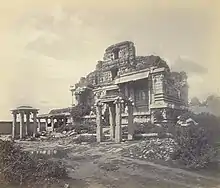
The Vijayanagara Empire, (also called Karnata Empire, and the Kingdom of Bisnegar by the Portuguese) was based in the Deccan Plateau region in South India. It was established in 1336 by Harihara I and his brother Bukka Raya I of Sangama Dynasty. The empire rose to prominence as a culmination of attempts by the southern powers to ward off Islamic invasions by the end of the 13th century. It lasted until 1646, although its power declined after a major military defeat in 1565 by the combined armies of the Deccan sultanates. The empire is named after its capital city of Vijayanagara, whose ruins surround present day Hampi, now a World Heritage Site in Karnataka, India. The writings of medieval European travelers such as Domingo Paes, Fernão Nunes, and Niccolò Da Conti, and the literature in local languages provide crucial information about its history. Archaeological excavations at Vijayanagara have revealed the empire's power and wealth.
Quotes
- [The Vijayanagar kings allowed] that every man may come and go, and live according to his own creed without suffering any annoyance, and without enquiring whether he is a Christian, Jew, Moor or Heathen. Great equity and justice is observed by all.
- Duarte Barbosa. The Book of Duarte Barbosa, vol. I, p. 202. quoted from Lal, K. S. (1999). Theory and practice of Muslim state in India. New Delhi: Aditya Prakashan. Chapter 2
- Vijayanagar—the name both of a kingdom and of its capital—is a melancholy instance of forgotten glory. In the years of its grandeur it comprised all the present native states of the lower peninsula, together with Mysore and the entire Presidency of Madras.
- Will Durant and Ariel Durant, The Story of Civilization, Book I, Our Oriental Heritage (1935) (V. THE ZENITH OF THE SOUTH)
- Krishna Raya, who ruled Vijayanagar in the days of Henry VIII, compares favorably with that constant lover. He led a life of justice and courtesy, gave abounding alms, tolerated all Hindu faiths, enjoyed and supported literature and the arts, forgave fallen enemies and spared their cities, and devoted himself sedulously to the chores of administration. A Portuguese missionary, Domingos Paes (1522), describes him as 'the most feared and perfect king that could possibly be; cheerful of disposition, and very merry; he is one that seeks to honor foreigners, and receives them kindly. . . . He is a great ruler, and a man of much justice, but subject to sudden fits of rage. . . . He is by rank a greater lord than any, by reason of what he possesses in armies and territories; but it seems that he has in fact nothing compared to what a man like him ought to have, so gallant and perfect is he in all things.'
- Will Durant and Ariel Durant, The Story of Civilization, Book I, Our Oriental Heritage (1935) (V. THE ZENITH OF THE SOUTH)
- The capital, founded in 1336, was probably the richest city that India had yet known. Nicolo Conti, visiting it about 1420, estimated its circumference at sixty miles; Paes pronounced it “as large as Rome, and very beautiful to the sight.” There were, he added, “many groves of trees within it, and many conduits of water”; for its engineers had constructed a huge dam in the Tungabadra River, and had formed a reservoir from which water was conveyed to the city by an aqueduct fifteen miles long, cut for several miles out of the solid rock. Abdu-r Razzak, who saw the city in 1443, reported it as “such that eye has not seen, nor ear heard, of any place resembling it upon the whole earth.” Paes considered it “the best-provided city in the world, . . . Ior in this one everything abounds.” The houses, he tells us, numbered over a hundred thousand—implying a population of half a million souls. He marvels at a palace in which one room was built entirely of ivory; “it is so rich and beautiful that you would hardly find anywhere another such.”66 When Firoz Shah, Sultan of Delhi, married the daughter of Vijayanagar’s king in the latter’s capital, the road was spread for six miles with velvet, satin, cloth of gold and other costly stuffs.67 However, every traveler is a liar.
- Will Durant and Ariel Durant, The Story of Civilization, Book I, Our Oriental Heritage (1935) (V. THE ZENITH OF THE SOUTH)
- In one day all this power and luxury were destroyed. Slowly the conquering Moslems had made their way south; now the sultans of Bijapur, Ahmadnagar, Golkonda and Bidar united their forces to reduce this last stronghold of the native Hindu kings. Their combined armies met Rama Raja's half-million men at Talikota; the superior numbers of the attackers prevailed; Rama Raja was captured and beheaded in the sight of his followers, and these, losing courage, fled. Nearly a hundred thousand of them were slain in the retreat, until all the streams were colored with their blood. The conquering troops plundered the wealthy capital, and found the booty so abundant "that every private man in the allied army became rich in gold, jewels, effects, tents, arms, horses and slaves." For five months the plunder continued: the victors slaughtered the helpless inhabitants in indiscriminate butchery, emptied the stores and shops, smashed the temples and palaces, and labored at great pains to destroy all the statuary and painting in the city; then they went through the streets with flaming torches, and set fire to all that would burn. When at last they retired, Vijayanagar was as completely ruined as if an earthquake had visited it and had left not a stone upon a stone. It was a destruction ferocious and absolute, typifying that terrible Moslem conquest of India which had begun a thousand years before, and was now complete.
- Will Durant and Ariel Durant, The Story of Civilization, Book I, Our Oriental Heritage (1935) (V. THE ZENITH OF THE SOUTH)
- Under the Rayas or Kings of Vijayanagar literature prospered, both in classical Sanskrit and in the Telugu dialect of the south. Krishna Raya was himself a poet, as well as a liberal patron of letters; and his poet laureate, Alasani-Peddana, is ranked among the highest of India's singers. Painting and architecture flourished; enormous temples were built, and almost every foot of their surface was carved into statuary or bas-relief. Buddhism had lost its hold, and a form of Brahmanism that especially honored Vishnu had become the faith of the people. The cow was holy and was never killed; but many species of cattle and fowl were sacrificed to the gods, and eaten by the people. Religion was brutal, and manners were refined.
- Will Durant, Our oriental heritage
- A European traveller named Barbosa who observed goings-on in Vijayanagara described the king as allowing great freedom, so that every man could come and go as he wished, living according to his own beliefs without suffering any persecution, and without having to be questioned as to whether he was a Christian, Jew or Moor. He said that the governors ruled with justice.’ Krishnadevaraya, and then his brother Achyuta, made gifts to brahmans of all sects, and gave land for both Shaiva and Vaishnava enterprises. A Hindu named Rangai Nayakayya gave funds for a mosque to be constructed. Devaraya II built a mosque in the capital for his Muslim soldiers." And Ramaraja, Krishnadevaraya’s son-in-law, used very inclusive symbolism in the state ceremony in which Muslim soldiers offered their obeisance to him: a copy of the Qur’an was placed before the king so that the soldier would be honouring his faith when he bowed, showing not ‘either/or’ but ‘both/and’ symbolism. This inclusive symbolism was like the coin of Caesar, using not force but persuasion.”
- William J. Jackson’s book Vijayanagara Voices: Exploring South Indian History and Hindu Literature
- 'The battle took place on Tuesday, 23 January, 1565. The Vijayanagara army commenced attack in right earnest and the right and left wings of the confederate army were thrown into such disorder that their commanders were almost prepared to retreat when the position was saved by Hussain who opposed the enemy with great valour. The fighting was then continued and the loss of life on both sides was heavy. But it did not last long and its fate was determined by the desertion of two Muhammadan commanders under Ramraja. Caesar Frederick, who visited Vijayanagara in 1567, said that each of these commanders had under him seventy to eighty thousand men and the defeat of Vijayanagara was due to their desertion. Ramaraja fell into enemy's hands and was beheaded on the order of Hussain.'120
- R.C. Majumdar (ed.), The History and Culture of the Indian People, Volume VII, The Mughal Empire, Bombay, 1973, p. 425. Quoted in S.R.Goel, The Calcutta Quran Petition (1999) ISBN 9788185990583
- 'The Hindoos, according to custom, when they saw their chief destroyed, fled in the utmost disorder from the field, and were pursued by the allies with such success, that the river was dyed red with their blood. It is computed, by the best authorities, that above one hundred thousand infidels were slain during the action and in the pursuit. The plunder was so great that every private man in the allied army became rich in gold, jewels tents, horses, and slaves, the kings permitting every person to retain what he acquired, reserving the elephants only for their own use. Letters with accounts of this important victory were despatched to their several dominions, and to the neighbouring states, while the kings themselves, shortly after the battle, marched onwards into the country of Ramraj, as far as Anagoondy, and the advanced troops penetrated to Beejanuggur which they plundered, razed the chief buildings to the ground, and committed every species of excess.'
- TArIkh-i-Farishtah, translated into English by John Briggs as History of the Rise of the Mahomedan Power in India, New Delhi reprint, 1981, Volume III, p. 79. Quoted in S.R.Goel, The Calcutta Quran Petition (1999) ISBN 9788185990583
- 'The third day saw the beginning of the end. The victorious Mussulmans had halted on the field of battle for rest and refreshment, but now they had reached the capital, and from that time forward for a space of five months Vijayanagar knew no rest. The enemy had come to destroy, and they carried out their object relentlessly. They slaughtered the people without mercy; broke down the temples and palaces, and wreaked such savage vengeance on the abode of the Kings, that, with the exception of a few great stone-built temples and walls, nothing now remains but a heap of ruins to mark the spot where once stately buildings stood. They demolished the statues, and even succeeded in breaking the limbs of the huge Narasimha monolith. Nothing seemed to escape them. They broke up the pavilions standing on the huge platform from which the kings used to watch festivals, and overthrew all the carved work. They lit huge fires in the magnificently decorated buildings forming the temple of Vitthalaswami near the river, and smashed its exquisite stone sculptures. With fire and sword, with crowbars and axes, they carried on day after day their work of destruction. Never perhaps in the history of the world has such havoc been wrought, and wrought so suddenly, on so splendid a city; teeming with a wealthy and industrious population in the fun plenitude of prosperity one day, and on the next seized, pillaged, and reduced to ruins, amid scenes of savage massacre and horrors beggaring description' The loot must have been enormous. Couto states that amongst other treasures was found a diamond as large as a hen's egg, which was kept by the Adil Shah.'
- Robert Sewell, A Forgotten Empire, New Delhi reprint, 1962, pp. 199-200. Quoted in S.R.Goel, The Calcutta Quran Petition (1999) ISBN 9788185990583
- At first the Hindus fought with success and nearly won the battle; but the issue was decided by the desertion of two Muslim commanders of Rama Raya's army, each in charge of seventy to eighty thousand men.
- About the watershed battle of Talikota on 23 January 1565 which broke the back of the Vijayanagara Empire
- Nilakantha Shastri: History of South India, pp.94-5, quoted in Elst, Koenraad (2014). Decolonizing the Hindu mind: Ideological development of Hindu revivalism. New Delhi: Rupa. p.344
- During the construction of the new road-some mounds which evidently marked the remains of destroyed buildings, were dug into, and in one of them were disclosed the foundations of a rectangular building with elaborately carved base. Among the debris were lumps of charcoal and calcined iron, probably the remains of the materials used by the Muhammadans in the destruction of the building. The stones bear extensive signs of having been exposed to the action of fire. That the chief buildings were destroyed by fire, historical evidence shows, and many buildings, notably the ViThalaswAmin temple, still bear signs, in their cracked and fractured stone work, of the catastrophe which overtook them…
- The most important temple at Vijayanagar from an architectural point of view, is the ViThalaswãmin temple. It stands in the eastern limits of the ruins, near the bank of the TuNgabhadra river, and shows in its later structures the extreme limit in floral magnificence to which the Dravidian style advanced… This building had evidently attracted the special attention of the Muhammadan invaders in their efforts to destroy the buildings of the city, of which this was no doubt one of the most important, for though many of the other temples show traces of the action of fire, in none of them are the effects so marked as in this. Its massive construction, however, resisted all the efforts that were made to bring it down and the only visible results of their iconoclastic fury are the cracked beams and pillars, some of the later being so flaked as to make one marvel that they are yet able to bear the immense weight of the stone entablature and roof above…”
- I think every Indian should make the pilgrimage to the site of the capital of the Vijaynagar empire, just to see what the invasion of India led to. They will see a totally destroyed town. Religious wars are like that. People who see that might understand what the centuries of plunder and slaughter meant. War isn't a game. When you lost that kind of war, your towns were destroyed, the people who built the towns were destroyed, you are left with a headless population. That's where modern India starts from...
- In 1522, the Portuguese traveler Domingos Paes had visited Vijayanagar, and reported that it was comparable in size to Rome, with a population of five hundred thousand. He called Vijayanagar “the best provided city in the world…for the state of this city is not like that of other cities, which often fail of supplies and provisions, for in this one everything abounds.” Inside the palace, he saw a room “all of ivory, as well the chamber as the walls from top to bottom, and the pillars of the cross-timbers at the top had roses and flowers of lotuses all of ivory, and all well executed, so that there could not be better—it is so rich and beautiful that you would hardly find anywhere another such.”
- Domingo Paes in Smith, The Oxford History of India. Quoted from Spencer, Robert (2018). The history of Jihad: From Muhammad to ISIS.
- When the sultans of Delhi lost their hold on the South, Bahmani and Vijayanagar kingdoms came to grips with each other. The wars between these two kingdoms generally ended in massacres. Only one instance should suffice to give an idea of this. Mulla Daud of Bidar vividly describes the fighting between Muhammad Shah Bahmani and the Vijayanagar king in 1366 in which “Ferishtah computes the victims on the Hindu side alone as numbering no less than half a million.” According to Ferishtah, Muhammad “So wasted the districts of Carnatic that for several decades they did not recover their natural population.”
- R. Sewell, Ferishtah, I, p.295. quoted from K.S. Lal, Indian Muslims, who are they, 1990.
- “The first Bhamani King, Alauddin Bahman Shah (1347-1358) despatched an expedition against the northern Canatic Hindu chieftains, and his booty included ‘1000 singing and dancing girls, Murlis, from Hindu temples’. In 1406 Sultan Tajuddin Firoz (1397-1422) fought a war with Vijayanagar and captured 60,000 youths and children from its territories. When peace was made Bukka gave, besides other things, 2,000 boys and girls skilled in dancing and music… His successor Ahmad Vali (1422-36) marched through Vijayanagar kingdom, ‘slaughtering men and enslaving women and children.” The captives were made Musalmans. Sultan Alauddin (1436-58) collected a thousand women in his harem. When it is noted that intermittent warfare between the Bahmani and Vijayanagar kingdoms continued for more than a century and half, the story of enslavement and conversions need not be carried on. Even ordinary soldiers used to get many slaves and, at the end of the Battle of Talikot (1565), ‘large number of captives consigned to slavery, enriched the whole of the Muslim armies, for the troops were permitted to retain the whole of the plunder.’ …”
- Lal, K. S. (1994). Muslim slave system in medieval India. New Delhi: Aditya Prakashan. Chapter 6, quoting The Cambridge History of India
- Ally Adil Shah, intent on adding to his dominions, and repairing the losses sustained by his father, entered into a close alliance with Ramraj; and on the occasion of the death of a son of that Prince, he had the boldness, attended only by one hundred horse, to go to Beejanuggur, to offer his condolence in person on that melancholy occasion. Ramraj received him with the greatest respect...
'Ally Adil Shah resolved to curb his [Ramraj's] insolence and reduce his power by a league of the faithful against him; for which purpose he convened an assembly of his friends and confidential advisers. Kishwur Khan Lary and Shah Aboo Toorab Shirazy, whose abilities had often been experienced, represented, that the King's desire to humble the pride of the Ray of Beejanuggur was undoubtedly meritorious and highly politic, but could never be effected unless by the union of all the Mahomedan kings of the Deccan, as the revenues of Ramraj, collected from sixty seaports and numerous flourishing cities and districts, amounted to an immense sum; which enabled him to maintain a force, against which no single king of the Mussulmans could hope to contend with the smallest prospect of success. Ally Adil Shah commanded Kishwur Khan to take measures to effect the object of a general league; and an ambassador was accordingly despatched without delay to sound Ibrahim Kootb Shah, and to open to him if prudent, the designed plan'
'Ibrahim Kootb Shah, who had been inwardly stung with indignation at the haughty insolence and the usurpations of Ramraj, eagerly acceded to the proposed alliance, and offered to mediate a union between Ally Adil Shah and Hoossein Nizam Shah, and even promised to obtain for the former the fort of Sholapoor, which had been the original cause of their disagreement. With this view Ibrahim Kootb Shah despatched Moostufa Khan Ardistany, the most intelligent nobleman of his court, to Ally Adil Shah, with orders, if he should find him still sincere in his intentions towards the league, to proceed from thence to Ahmudnuggur, and conclude the alliance'...'After some days it was agreed that Hoossein Nizam Shah should give his daughter Chand Beeby in marriage to Ally Adil Shah, with the fortress of Sholapoor as her dowry; and that he should receive the sister of that Prince, named Huddeea Sooltana, as a consort for his eldest son Moortuza; that a treaty of eternal friendship should be entered on between both states, and that they should unite sincerely to reduce the power of Ramraj; for which purpose it was resolved to march against him at the earliest practicable period. Hoossein Nizam Shah, Ally Adil Shah, Ibrahim Kootb Shah, and Ally Bereed Shah,117now began to make active preparations for the campaign against Ramraj'...'In the year A.H. 972 (1564 CE), the four princes, at the head of their respective armies, met on the plains of Beejapoor, and on the 20th of Jumad-ool-Awul (Dec. 26) of the same year marched from that neighbourhood. After some days they arrived at Talikote, and the armies encamped near the banks of the Krishna; where, as the country on the north bank belonged to Ally Adil Shah he entertained his allies with great splendour, and sent strict orders to all the governors of his dominions to forward supplies of provisions from their districts regularly all to the camp.'- About the planning of the conquest of Vijayanagara. TArIkh-i-Farishtah, translated into English by John Briggs as History of the Rise of the Mahomedan Power in India, New Delhi reprint, 1981, Volume III, p. 71-79.
- [Muhammad Shah had vowed to slaughter 100,000 infidels in the attack and] ‘the massacre of the unbelievers was renewed in so relentless a manner that pregnant women and children at the breast even did not escape the sword.’... About ten thousand of the enemy were slain in the pursuit; but the King’s thirst for vengeance being still unsatisfied, he command- ed the inhabitants of every place around Beejanuggur to be massacred. ... At this time, a favourite remarked to the King, that he had only sworn to slaughter one hundred thousand Hindus, and not to destroy their race altogether. The King replied, that though twice the number required by his vow might have been slain, yet till the Ray satisfied the musicians, be would neither make peace nor spare the lives of his subjects. To this the ambassadors. who had full powers, immediatdy agreed, and the money was paid on the instant. ... The ambassadors, seeing the King pleased, bowed their foreheads to the ground, and besought him to hear from them a few words. Being permitted to speak, they observed, that no religion required the innocent to be punished for the crimes of the guilty, more especially helpless women and children : if Krishna Ray had been in fault, the poor and feeble inhabitants had not been accessory to his errors. Mahomed Shah replied, that the decrees of Providence had ordered what had been done, and that he had no power to alter them.
- [King Dev Raya II (1419–49)] ‘gave orders to enlist Mussulmans (of his kingdom) in his service, allotting them estates, and erecting a mosque for their use in the city of Beejanuggar (Vijaynagar). He also commanded that no one should molest them in the exercise of their religion and moreover, he ordered a Koran to be placed before his throne on a rich desk, so that the faithful (Muslims) can perform their ceremony of obeisance in his presence without sinning against their laws.’
- When the sultans of Delhi lost their hold on the South, Bahmani and Vijayanagar kingdoms came to grips with each other. The wars between these two kingdoms generally ended in massacres. Only one instance should suffice to give an idea of this. Mulla Daud of Bidar vividly describes the fighting, between Muhammad Shah Bahmani and the Vijayanagar king iri 1366 in which “Ferishtah computes the victims on the Hindu.side alone as numbering no less than half a million’’. 5 According to Ferishtah, Muhammad “So wasted the districts of Carnatic that for several decades they did not recover their natural population.'”
- K.S. Lal Growth of Muslim Population in Medieval India (1973) 42 quoting Sewell, Firishta
- Subsequently, the Vijayanagara rulers succeeded in wresting a large part of the western coast, including Goa. Madhavamantri was appointed governor of Goa. ... Another inscription described how Madhava-mantri ousted the Turuska groups from Goa and re-consecrated the Saptanatha and other lingas that had been uprooted, “and made the trees of dharma sprout again which were burnt by the flames of fire of the wicked”.
- Jain, M. (2019). Flight of deities and rebirth of temples: Episodes from Indian history. 216, quoting (Ritti 2017: xxxiii, 105)
- Traditionally, the founding of the Vijayanagara Empire was interpreted as the reaffirmation of Hindu dharma in the face of the challenge from Islam. An interesting inscription stated that the divine cow, Kamadhenu complained to Shiva that is was very difficult to walk on one leg, as it no longer had all four. That was a proclamation that only a semblance of dharma remained. Shiva recognized the gravity of the situation and said he would send king Sangama, and dharma would stand firmly again. The inscription was a declaration that Vijayanagara was founded to re-instate dharma .
- Jain, M. (2019). Flight of deities and rebirth of temples: Episodes from Indian history., quoting (Ritti 2017: li) 310
- The city of Bidjanagar is such that the pupil of the eye has never seen a place like it, and the ear of intelligence has never been informed that there existed anything to equal it in the world.
- Abdur Razzak, quoted in Jain, M. (2019). Flight of deities and rebirth of temples: Episodes from Indian history. 311
- “And yet these foure Kings were not able to overcome this Citie and the King of Bezeneger, but by treason. This King of Bezeneger was a Gentile, and had, amongst all other of his Captaines, two which were notable, and they were Moores: and these two Captaines had either of them in charge threescore and ten or fourscore thousand men. These two Captaines being of one Religion with the foure Kings which were Moores, wrought means with them to betray their owne King into their hands. The King of Benzeneger esteemed not the force of the foure Kings his enemies, but went out of his Cities to wage battell with them in the fields; and when the Armies were joyned, the battell lasted but a while, not the space of four houres, because the two traiterous Captaines, in the chiefest of the fight, with their campanies turned their faces against their King, and made such disorder in his Armie, that as astonied they set themselves to flight...and the foure Kings of the Moores entered the Citie Bezeneger with great triumph, and there they remained sixe moneths, searching under houses and in all places for money and other things that were hidden, and then they departed to their owne Kingdomes, because they were not able to maintayne such a Kingdome as that was, so farre distant from their owne countrie”.
- Sack of the city described by Caesare Federici, in (Filliozat 2001: 318-326). quoted from Jain, M. (2019). Flight of deities and rebirth of temples: Episodes from Indian history.334 ff
- “... in the course of the war, plundered and destroyed the city of Bisnaga, which was the royal city, and capital of the whole of the kingdom, so populous, rich and well-fitted that there were within its enclosure about a thousand temples, they say. The ruins that remain still show evidently that it was one of the wonders of the East”.
- Account by a Jesuit in 1583 CE recording the devastation of Vijayanagara, in (Filliozat 2001: 329-330). quoted from Jain, M. (2019). Flight of deities and rebirth of temples: Episodes from Indian history. 334 ff