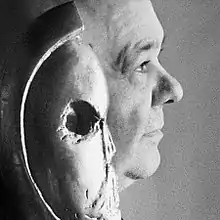
Umberto Pettinicchio
Umberto Pettinicchio (born 1943) is an Italian contemporary painter and sculptor.
Quotes about Pettinicchio
- Pettinicchio is a visceral. A talented artist. One of the most original, most significant personalities of the new Italian art. (Pedro Fiore)
- Pettinicchio places himself in a context that rejects the aesthetic solution as unifying the relationship between man and the world. For the way Pettinicchio translates into the sign the images that contradict the banal objectivity of vision and for the intensity with which he rejects the easy chromatic combination, aesthetic pacifier of the tension of the contents, the artist puts us in an immediacy of communication that he makes a distinction between the whole series of painters who are formally related to him but who remain in a vagueness from which Pettinicchio is decidedly alien. Immediacy but not ease of communication. If you are not able to understand the suggestion that comes to us from these dense works by Pettinicchio, so different from all the painting that comes down to us from the nineteenth century. Communication is not easy .... it is a question of understanding, beyond the verisimilitude of the forms, what is the internal content that animates them. (Raffaele de Grada)
- Pettinicchio stands at the antipodes of nineteenth-century objectivity and the realist figurative demands of our time (Roberto Sanesi)
Quotes
- I thought a lot about the beauty of Leonardo's Mona Lisa, we have two expressions that are composed on the same icon: usually to express an expression our whole body moves in that direction, to create another expression we need a different time. These two times, the sadness and the smile, which point out our duality are characterized at the same time. It creates a displacement. It's as if we could not grasp both things together. Hence the perception of that extraordinary beauty.
- Umberto Pettinicchio late interview, La spiritualita’ oltre l’icona, shantimandir.eu, 2001.
- It is an intense blue, born after a certain period and has in turn a key to reading. When we spread it on the sculpture, the story is burned, because the color is so vivid that what is written in the sculpture goes into the background. So, there is a process of liberation and even if the work and the blue seem very different, they have a common denominator between them, the motive of poetics. We often allow ourselves to be conditioned by the scenic apparatus.
- "Le colline della Brianza e i suoi stupendi campanili sono la mia ispirazione" Umberto Pettinicchio, Castenuovo, Lecco, January 31, 2010; Elvira Carella, ilgiorno.it.
- Several times I have wondered what was the use of painting, sculpting, making art .. and if this were nothing more than a way to seek God.
- ... In this shattered and full of collision society, where each of us speaks our own language, no one can listen to us unless we speak the language of love, that universal language that governs the whole universe. The one that has different names: Christ, Buddha, Mohammed, Allah, Jehovah, Zarathustra, Sathya Sai Baba, Krishna, Shiva, Vishnu and many others.
- ... the self and the other indicate a common but different code, because everything is divine expression.
External links
This article is issued from Wikiquote. The text is licensed under Creative Commons - Attribution - Sharealike. Additional terms may apply for the media files.