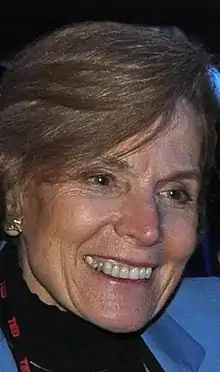
Sylvia Earle (born 1935) is an American marine biologist, explorer, author, and lecturer. Since 1998 she has been a National Geographic explorer-in-residence. Earle was the first woman to be appointed chief scientist of the U.S. National Oceanic and Atmospheric Administration, and was named by Time Magazine as its first Hero for the Planet in 1998.
Quotes
- I want to get out in the water. I wanted to see fish, real fish, not fish in a laboratory.
- Interview: Sylvia Earle Undersea Explorer, Academy of Achievement, January 27, 1991
- People ask: Why should I care about the ocean? Because the ocean is the cornerstone of earth's life support system, it shapes climate and weather. It holds most of life on earth. 97% of earth's water is there. It's the blue heart of the planet — we should take care of our heart. It's what makes life possible for us. We still have a really good chance to make things better than they are. They won't get better unless we take the action and inspire others to do the same thing. No one is without power. Everybody has the capacity to do something.
- Quoted in the 2010 documentary film Bag It
- The next time you dine on sushi -- or sashimi, or swordfish steak, or shrimp cocktail, whatever wildlife you happen to enjoy from the ocean -- think of the real cost. For every pound that goes to market, more than 10 pounds, even 100 pounds, may be thrown away as bycatch. This is the consequence of not knowing that there are limits to what we can take out of the sea.
- Quote from her 2009 TED talk
- I hope Jill Tarter's wish to engage Earthlings includes dolphins and whales and other sea creatures in this quest to find intelligent life elsewhere in the universe. And I hope, Jill, that someday we will find evidence that there is intelligent life among humans on this planet. (Chuckles) Did I say that? I guess I did.
- Quote from her 2009 TED talk
- The ocean is large and resilient, but it is not too big to fail. What we are taking out of the sea, what we are putting into the sea are actions that are undermining the most important thing the ocean delivers to humankind – our very existence.
- BREAKING: Dr. Sylvia Earle Boldly Addresses the UN To Urge Legal Protection for High Seas. Mission Blue. Retrieved on 28 January 2015.
- No ocean, no life. No blue, no green. No ocean, no us.
- BREAKING: Dr. Sylvia Earle Boldly Addresses the UN To Urge Legal Protection for High Seas. Mission Blue. Retrieved on 28 January 2015.
- Just as we have the power to harm the ocean, we have the power to put in place policies and modify our own behavior in ways that would be an insurance policy for the future of the sea, for the creatures there, and for us, protecting special critical areas in the ocean.
- The National Oceanic And Atmospheric Administration in:Effect of Violent Video Games on Kids; Dogs' Efforts to Keep Mail Safe; Spanish Government Sues Over Oil Spills,CNN.com, May 18, 2003
Interview with Time (2021)
- If I were an evil alien wishing to alter the nature of life on earth, I would change the temperature of the ocean, I would change the chemistry. That is exactly what we are doing: excess carbon dioxide in the atmosphere becomes excess carbon dioxide in the ocean that becomes carbonic acid. The ocean is becoming more acidic. That changes everything.
- Right now a disproportionate bite out of the ocean is being taken by a relatively small number of countries doing industrial fishing. We’ve got to get over this idea that wildlife from the ocean is essential for our food security. What we now are beginning to understand is the high cost of eating fish. What does it take to make a pound of tuna? A lot of halibut or cod. What makes the halibut? Smaller fish. What do they eat? Krill. Krill eat phytoplankton, zooplankton. Over the years thousands of pounds of phytoplankton make a single pound of tuna. So that tuna is expensive in terms of the carbon that it has captured. The more fish we take out of the sea, the more carbon dioxide gets released into the atmosphere.
- What is the single most important thing we can do for the oceans today?
- Deep-sea mining. Some are buying into the lie that we should be taking minerals that are necessary for today’s generation of [EV] batteries, like lithium, cobalt and nickel, from the deep sea, because who cares what happens in the deep sea? These deep-sea systems are full of life and are part of the biogeochemical cycling systems that hold Earth steady. If Earth functions like a big computer system with all these little wires and lights that we don’t understand but we know it keeps us alive, would we want to get in there and take those little lights out because we don’t understand how they work?
- What is the biggest threat to the ocean right now?
- I’ve had the privilege of living underwater on 10 different occasions. It has enabled me to get to know individual moray eels, individual groupers, even individual lobsters. They all have faces, they have attitudes. They have sensory systems much like our own. And yet we somehow harden ourselves to think they don’t feel pain. We pride ourselves on being “humane” but it doesn’t translate to the way we treat animals in the sea.
- Knowledge is the superpower of the 21st century. Even the smartest people alive when I was born did not know what 10-year-olds today have available to them. That’s truly cause for hope.
- The ocean is the blue heart of the planet.
- Change happens because of individuals who team up with others or inspire others. And soon you’ve got 10 or 100 or 1,000, and then you’ve got a movement.
Interview with NPR (2021)
- I've had a chance to live underwater 10 times now in various underwater laboratories and to use more than 30 different kinds of submarines, thousands of hours seeing the ocean from the inside out and realizing this is not just rocks and water; this is alive. It's a soup, like minestrone, but all the little pieces are alive.
- Being a child in Florida when my parents moved there in 1948 and witnessing the changes in the coastline, the marshes that I first discovered - finding horseshoe crab eggs, these tiny little creatures prospering in really clear water and going out on a dock at night and seeing these bioluminescent creatures just flashing and glowing - and witnessing the change, that the waters became not beautiful, clear and blue but muddy - that was powerful incentive to say, why are we doing this?
- it's still there - the habit of thinking that the ocean is too big to fail. And we're still taking life in the ocean for granted. We still think that we have the capacity to take fish on a scale that we currently are and continue to do it forever.
- I think one of the most important trends is the awareness and willingness to embrace places and to recognize that protecting nature, the natural systems, have benefits back to us in terms not just of better health, not just because they're beautiful - it's not even a choice anymore; it's necessary for our existence. We have to realize we're a part of nature. We can see the connection between trees and climate. We can see connection between the forests and the ocean, the phytoplankton capturing carbon, generating oxygen, maintaining a planet that works in our favor. This is common sense.
- we can't be happy or healthy if we don't take care of our life support system, the planet.
- The 21st century humans are poised to be the heroes for all time because we're armed with a superpower of knowing that we have to change our attitude about the world that keeps us alive, that we can't just continue mining and, you know, taking and taking. We have to be aware of the consequences.
Sea Change: A Message of the Oceans (1995)
Introduction
- Without an ocean, there would be no life-no people anyway
- There's plenty of water in the universe without life, but nowhere is there life without water.
- The living ocean drives planetary chemistry, governs climate and weather, and otherwise provides the cornerstone of the life-support system for all creatures on our planet, from deep-sea starfish to desert sagebrush. That's why the ocean matters. If the sea is sick, we'll feel it. If it dies, we die. Our future and the state of the oceans are one.
- Sometimes, I try to imagine what intelligent aliens, viewing Earth from afar, might think about the sea. From their perch in the sky, they could immediately see what many earthlings never seem to grasp: that this is a planet dominated by saltwater! In fact, the ocean is the cornerstone of the systems that sustain us: every breath we take is linked to the sea.
- Sometimes I try a poetic approach and describe how luminous, rainbow-colored jellies, starlike planktonic creatures, giant squid, translucent pink prawns, gray dolphins, brown lizards, spotted giraffes, emerald mosses, rustling grasses, every leaf on every tree and all people everywhere, even residents of inland cities and deserts who may never see the sea, are nonetheless dependent upon it.
- Common sense forces me to consider first the incredible sweep of time that preceded this moment and the ocean's great age, relative to the infinitesimally small fragment of time enjoyed thus far by humankind.
- Our soaring population may suggest success as a species, but the environmental price of modern civilization is high, and our prosperity may be short-lived.
- In the rush to "develop" and use the legacy 4.6 billion years in the making, we have struck the earth like a slow-motion comet, wielding powerful new forces of change, rivaling and compounding the impact of natural storms, volcanoes, earthquakes, disease, fires-even, it now seems, nudging the grand and gradual planetary processes that cause ice ages to come and go.
- Highways crisscross the land, simultaneously forming pathways and barriers.
- This much is certain: We have the power to damage the sea, but no sure way to heal the harm.
- All things considered, it seems so reasonable that people should care about the oceans and should be driven by a sense of urgency about knowing more. One of the great unsolved mysteries of the sea is why they don't. An aquatic atmosphere covers most of the planet's surface, encompasses the continents, and provides a home for most of life on Earth, yet it remains for humankind inaccessible and unknown, by and large ignored, overlooked, or simply taken for granted. How is this possible?
- Since the 1800's, numerous species and entire complex living ecosystems many millions of years in the making have been decimated or significantly altered, from populations of whales and other large mammals to dozens of commercially valued fish species, all marine turtles, many sharks, and numerous small creatures including certain krill, crabs, and shrimp. Worldwide, the living network of microorganisms that shape the basic ingredients of the ocean's "living soup" has been tugged, the system nudged, with unknown consequences. Far too little is known about the earth's living processes to know or predict the specific consequences of our tinkering, but the outcome is not likely to be favorable for humankind.
- Curiously, those who claim to believe that the earth and all living things were created by God in fact appear to place greater value on human works and the judgment of mankind.
- No one can say for sure what such disruptions may mean for human well-being or survival; clearly, however, a global experiment is in progress, and we are in the middle of it, as a part of, not apart from, the rest of life on Earth. Unlike most other participants, though, we have the ability to alter the course of events, and we shall, either through conscious decisions aimed at making a difference, or by default, through inaction or ignorance.
- This is a time of pivotal, magnified significance for humankind. The fabric of life and the physical and chemical nature of the planet have been significantly altered through decisions already made by our predecessors and those now living; what happens next depends on what we do, or do not do, individually and collectively, in the next few decades. Depending on choices we make, our species may be able to achieve a viable, sustainable future, or we may continue to so alter the nature of the planet that our kind will perish.
- on balance, if I had to choose the most interesting and important time in all of human history to live, it would be now. As never before, and perhaps as never again, the choices made in the near future will determine mankind's success, or lack of it. These are the "good old days" sure to be envied by those in the future.
- Far and away the greatest threat to the sea and to the future of mankind is ignorance. But with knowing comes caring, and with caring, the hope that maybe we'll find the Holy Grail of understanding, strike a balance with the natural systems that sustain us, and thus achieve an enduring place for humankind on a planet that got along without us for billions of years and no doubt could do so again.
Chapter 17
- As I walked solemnly over the blackened, blistered remains of what had been a friend's home, it was clear that those with whom I share the present time matter most: family, friends, acquaintances, members of my species throughout the world, and ranging beyond humankind, to other creatures I know personally or have met and admired on their own terms, from great humpback whales who turned their eyes to meet mine to the three Stellar's jays that recently fledged from a nest over my backdoor. I wish them well, want them to prosper, will take measures to protect them, if I can...
- (My parents and grandparents) witnessed the start of an era of unprecedented global consumption of living resources, the transformation of an earthly paradise 4.6 billion years in the making skimmed for the short-term service of a single insatiable species.
- Despite clear evidence that ocean ecosystems are collapsing and fish populations can not sustain commercial taking, huge nets, trawlers, and factory ships are still being deployed, and more are being built.
- In the past few decades-my lifetime-the sea has changed; with each passing year, pressures on ocean resources and ocean ecosystems increase; the size of the ocean does not.
- A few individuals, armed with modern technology, can wield enormous destructive power. One person with a bulldozer can, in a few days, eliminate a forest that has been quietly building for millennia; one fisherman deploying miles of drift nets can wipe out entire seagoing societies...But just as individuals can and do negatively impact the course tory, so can and do individuals make a positive difference.
- Part of human impact on the earth relates to our swiftly growing numbers. If we do not take deliberate, conscious action to maintain a reasonable balance between the numbers of people and the environmental wealth required to sustain us, nature will make appropriate adjustments, and famine, disease, and wars-the predictable outcomes of living beyond one's environmental means, of overspending environmental capital-will ultimately force a cruel discipline.
- One of my personal heroes is William Perrin
- To ensure a decent quality of life for the rest of our lives, as well as for all those who follow, we must develop global policies that recognize the interdependence of life and the need for nations to agree on mutually beneficial measures to protect and maintain the basic elements of life support, on a planetary scale. But it is difficult to be concerned
- If I had to name the single most frightening and dangerous threat to the health of the oceans, the one that stands alone yet is at the base of all the others is ignorance: lack of understanding, a failure to relate our destiny to that of the sea, or to make the connection between the health of coral reefs and our own health, between the fate of the great whales and the future of humankind. There is much to learn before it is possible to intelligently create a harmonious, viable place for ourselves on the planet. The best place to begin is by recognizing the magnitude of our ignorance, and not destroy species and natural systems that we cannot re-create nor effectively restore once they are gone.
- Perhaps with knowing will come caring, and with caring, an impetus toward the needed sea change of attitude, one that combines the wisdom of science and the sensitivity of art to create an enduring ethic.
- We have an opportunity, now, to achieve for humankind a prosperous, enduring future. If we fail, through inability to resolve thorny issues, or by default born of indifference, greed, or lack of knowledge, our kind might well be a passing short-term phenomenon, a mere three or four million-year blip in the ancient and ongoing saga of life on Earth.
External links
 Media related to Sylvia Earle on Wikimedia Commons
- National Geographic page
- Mission Blue
This article is issued from Wikiquote. The text is licensed under Creative Commons - Attribution - Sharealike. Additional terms may apply for the media files.