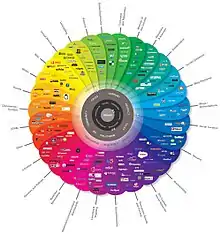
Diagram depicting the many different types of social media
Social media are computer-mediated tools that allow people, companies and other organizations to create, share, or exchange information, career interests, ideas, and pictures/videos in virtual communities and networks.
Quotes
- Many of the parents I spoke to worried that their kids’ digital habits — round-the-clock responding to texts, posting to social media, obsessively following the filtered exploits of peers — were partly to blame for their children’s struggles.
- Benoit Denizet-Lewis, ""Why Are More American Teenagers Than Ever Suffering From Severe Anxiety?", New York Times’ Magazine, (Oct 11, 2017); as quoted in "Anxiety is Now the Most Pressing Mental Health Problem For American Teens" Drake Baer, Thrive Global, (October 16, 2017).
- With social media, the personal becomes the public in a way that a lot of kids don't know how to handle it. Even bullying used to be more of an isolated act. Even if it happened in the lunchroom, ten people would see it. Now a thousand people see it.
- Guy Diamond in "Anxiety is Now the Most Pressing Mental Health Problem For American Teens" by Drake Baer, Thrive Global, (October 16, 2017).
- Psychologist Chris Ferguson of Stetson University says that both the negative and positive differences identified in the research are small. "My takeaway from this is for the most part, it looks like screen use, in general, and social media use have relatively little impact on most of the outcomes the authors are looking at, with maybe the exception of sleep," he says.
- Chris Ferguson as quoted by Sara Kiley Watson, “A Look At Social Media Finds Some Possible Benefits For Kids”, Shots, NPR, (June 19, 2018)
- How lasting the impact of social media will have is yet to be determined, but one thing for sure, it has turned the chain of influence upside down. Today the reader, the lowly reader, that presumably passive consumer of all the great insight handed down by the reporter, confirmed by the analyst, attested to by the reference customer—this reader, I say, has now become the writer! Except it is not a reader/writer. It is reader/writers at large, many readers, the wisdom (or madness) of crowds. We have embarked upon the world's largest and longest cocktail party, and every issue imaginable is up for grabs.
- Paul Gillin, Geoffrey A. Moore (2009), The New Influencers: A Marketer's Guide to the New Social Media. p. vii
- All that stuff about mainstream social media is interesting enough, which is to say not at all interesting.
- Lee Konstantinou, Johnny Appledrone vs. the FAA in Ed Finn & Kathryn Cramer (eds.) Hieroglyph: Stories and Visions for a Better Future (2014), ISBN 978-0-06-220469-1, p. 199
- If you want to help the cause of informational freedom, which is the only true religion, your talents as a social media consultant are irrelevant.
- Lee Konstantinou, Johnny Appledrone vs. the FAA in Ed Finn & Kathryn Cramer (eds.) Hieroglyph: Stories and Visions for a Better Future (2014), ISBN 978-0-06-220469-1, p. 200
- It's unbearable to think any young person should feel there is no other option but to end their life because of bullying on social networking sites.
- Claire Lilley, NSPCC safer technology expert, quoted in BBC News, "One in five children bullied online, says NSPCC survey", August 11, 2013.
- Social media makes it extraordinarily easy to join crusades, express solidarity and outrage, and shun traitors. Facebook was founded in 2004, and since 2006 it has allowed children as young as 13 to join. This means that the first wave of students who spent all their teen years using Facebook reached college in 2011, and graduated from college only this year.
These first true “social-media natives” may be different from members of previous generations in how they go about sharing their moral judgments and supporting one another in moral campaigns and conflicts. We find much to like about these trends; young people today are engaged with one another, with news stories, and with prosocial endeavors to a greater degree than when the dominant technology was television. But social media has also fundamentally shifted the balance of power in relationships between students and faculty; the latter increasingly fear what students might do to their reputations and careers by stirring up online mobs against them.- Greg Lukianoff, Jonathan Haidt, "The Coddling of the American Mind", The Atlantic, (September 2016).
- After it was revealed that Facebook was working on a version of Instagram for children under 13, a bipartisan group of 44 attorneys general wrote a letter to Zuckerberg this month with a simple message: Stop.
"Use of social media can be detrimental to the health and well-being of children, who are not equipped to navigate the challenges of having a social media account," the letter reads.- National Association of Attorneys General, “Re: Facebook’s Plans to Develop Instagram for Children Under the Age of 13”, as quoted by Miles Parks, “Facebook Calls Links To Depression Inconclusive. These Researchers Disagree”, All Things Considered, NPR, (May 18, 2021)
- The effect of this is there is no longer a free and open social media company or site for any American to get on any longer. Because these big companies—Apple, Amazon, Google—they have just destroyed what was likely a billion dollar company, and, poof, it's gone.
- But it's more than the just the financial aspect of that. Republicans have no way to communicate. It doesn't even matter if you're Republican or conservative, if you don't want to be regulated by left-wingers that are at Twitter and Facebook and Instagram, where you get shadow-banned and nobody gets to see you and they get to decide what's violent or not violent, it's preposterous
- Late capitalism is like your love life: it looks a lot less bleak through an Instagram filter.
- Laurie Penny, "Life Hacks of the Poor and Aimless."
- What happens on social media doesn’t stay on social media. Online violence is real world violence.
- Discussing political developments in the six years between leaving "The Daily Show" and starting a new show, “The Problem with Jon Stewart,” on Apple TV+ this fall, Stewart said social media algorithms have been a key factor in driving increased political polarization.
“We're adjusting to a new information and political ecosystem. … The delivery system is more sophisticated, more robust and more ubiquitous," he said. "It helps radicalize in a faster way or a deeper way. We have algorithms that make sure that if you are starting to lean toward something bad … then the algorithm says, ‘I've got a four-hour manifesto you've got to see.’ We have created a machine that makes that kind of radicalization more efficient.”- Jon Stewart as quoted by Craig Howie, “Jon Stewart warns more risks to the political system than Trump”, Politico, (10/17/2021)
- "The correlational evidence showing that there is a link between social media use and depression is pretty definitive at this point," said Jean Twenge, a psychology professor at San Diego State University. "The largest and most well-conducted studies that we have all show that teens who spend more time on social media are more likely to be depressed or unhappy."
- Jean Twenge as quoted by Miles Parks, “Facebook Calls Links To Depression Inconclusive. These Researchers Disagree”, All Things Considered, (May 18, 2021)
- Listening continuously and taking notes for an hour is an unusual cognitive experience for most young people. Professors should embrace — and even advertise — lecture courses as an exercise in mindfulness and attention building, a mental workout that counteracts the junk food of nonstop social media.
- Molly Worthen "Lecture me. Really." The New York Times, (October 17, 2015).
See also
External links
This article is issued from Wikiquote. The text is licensed under Creative Commons - Attribution - Sharealike. Additional terms may apply for the media files.