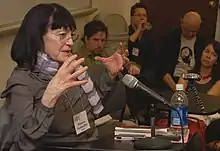
Roxanne Dunbar-Ortiz
Roxanne Dunbar-Ortiz (born September 10, 1939) is an American historian, writer and feminist.
Quotes
- Teaching Native American studies, I always begin with a simple exercise. I ask students to quickly draw a rough outline of the United States at the time it gained independence from Britain. Invariably most draw the approximate present shape of the United States from the Atlantic to the Pacific-the continental territory not fully appropriated until a century after independence. What became independent in 1783 were the thirteen British colonies hugging the Atlantic shore. When called on this, students are embarrassed because they know better. I assure them that they are not alone. I call this a Rorschach test of unconscious 'manifest destiny,' embedded in the minds of nearly everyone in the United States and around the world. This test reflects the seeming inevitability of US extent and power, its destiny, with an implication that the continent had previously been a land without people
- An Indigenous Peoples’ History of the United States (2015)
- I was also becoming more and more troubled by male chauvinism in the movement… Returning to the United States and organizing in the Boston area, I got angrier and angrier at men in the Students for a Democratic Society (SDS) and the anti-draft movement, the motto of which was, “Girls say yes to boys who say no.” I hadn’t felt oppressed so much directly, but of course I was, although I had been treated as a kind of “honorary” man. Once I started taking a feminist stand I got condemned. It was pretty hard to take at the time. And male chauvinism had terrible consequences for the women’s movement and for the development of the left, because it took some of the strongest feminists out of the Left and made the Left unwelcoming to newly politicized young women.
- On her early experiences as an activist in "A sense of hope and the possibility of solidarity" in International Socialist Review
- I think Marxism is a hard sell in the Native movement and for African Americans but less so for Mexican Americans because of their political genealogies. Today it’s even difficult for Chicanos, as well as Native Americans, because Marxism is deemed just Western epistemology or a Western worldview. There is of course a lot of Eurocentrism in Marx’s early writings. There is the idea of progress, but people don’t look at his later work enough, when he was getting into ethnology…
- On how people of color may receive Marxism in "A sense of hope and the possibility of solidarity" in International Socialist Review
- The left blames white nationalism. The right blames mental illness. Neither explains that it happens often here and nowhere else. But mass shootings account for a very small number of gun deaths: Many more women are killed in their home by guns. Men used to just knock women around, but rarely did death result. But with a gun on hand, there's a death. Half of the gun deaths are suicide. The proliferation of guns is a huge problem, but its cause is not lack of regulations. There were lots of regulations in the '70s when this started; going postal and school shootings started in the '70s.
- On how she views gun violence in the United States in “Roxanne Dunbar-Ortiz: ‘The Second Amendment is Almost a Time Bomb That Was Planted in the Constitution’” in Willamette Week (2018 Feb 21)
- This rise of the Second Amendment is almost a time bomb that was planted in the Constitution. A mandate for the legality of settler violence and settler sovereignty. What's that right about? It's about taking all the property. They're a vestige, but they're very powerful. They have a voice in the presidency and in the Congress.
- On her view of the Second Amendment in “Roxanne Dunbar-Ortiz: ‘The Second Amendment is Almost a Time Bomb That Was Planted in the Constitution’” in Willamette Week (2018 Feb 21)
- I was an anti-war, civil rights and women’s liberation activist during the 1960s while a graduate student at UCLA. It was actually my dissertation research that led me to involvement in the American Indian Movement and the International Indian Treaty Council in 1974.
- Interview (2015)
- (Thanksgiving has) never been about honoring Native Americans. It’s been about the origin story of the United States, the beginning of genocide, dispossession and constant warfare from that time—actually, from 1607 in Jamestown—until the present. It’s a colonial system that was set up.
- Interview (2016)
- Why celebrate Columbus? It was the onset of colonialism, the slave trade and dispossession of the Native people of the Americas. So, that is celebrated with a federal holiday. That’s followed then by Thanksgiving, which is a completely made-up story to say the Native people welcomed these people who were going to devastate their civilizations, which is simply a lie. And then you go to Presidents’ Days, the Founding Fathers, in February, and celebrate these slaveowners, Indian killers. George Washington headed the Virginia militia for the very purpose of killing Native people on the periphery of the colony, before, you know, when it was still a Virginia colony. And then we have the big day, the fireworks, July 4th, independence, which is probably the most tragic event in world history, because it gave us—it gave the world a genocidal regime under the guise of democracy. And that’s really the—I’m a historian, so that’s the historical context that I think we have to see Thanksgiving in, that it is a part of that mythology that attempts to cover up the real history of the United States.
- Interview (2016)
Interview with Democracy Now (2021)
- it was Berkeley that first recognized Indigenous Peoples’ Day in 1992 during the quincentennial. San Francisco came, I think, about five or six years later. But Berkeley — you know, things start in Berkeley. People think they’re crazy there, and then suddenly it’s everywhere.
- I never thought I would see it, you know, in the 1960s or '70s. It didn't seem like there would ever be any questioning of the role of Columbus. But it will be a long struggle still. It’s just not appropriate to celebrate Columbus and Indigenous peoples on the same day. It’s a contradiction. One is a genocidal enslavement, is what Columbus represents. And the situation of Native people today, still under colonialism, with shrunken land bases and not true sovereignty, is the fruit of that beginning, and they’re completely contradictory.
- (JFK) was Catholic and a child of Irish immigrants, and this had never happened before, president that was not Anglo-Saxon or Scots-Irish and descended from the original settlers. So he had quite a hill to climb to make himself palatable.
- there was no Italy — Columbus was from Genoa, a city-state. He died in Spain. So, you know, it’s a very weak link to Italianness. And, of course, Italians have such illustrious people they can celebrate, that everyone celebrates — Michelangelo, Vivaldi and, of course, for us on the left, Sacco and Vanzetti.
Interview (2008)
- Thanks to the inspiration of Elizabeth Martinez, who founded and published El Grito del Norte in Española, New Mexico, during the late 1960s and early 1970s, I decided to write my doctoral dissertation on the history of land tenure in northern New Mexico. Only through understanding history and land, I believed, could the present be understood.
- Simon J. Ortiz, writer and poet; Petuuche Gilbert; and Maurus Chino of Acoma Pueblo have given me insights into and understanding of the Pueblo Indian perspective. In fact, they have untiringly educated me in hopes that my work would be useful for their people.
- U.S. leftists do not want to really acknowledge that they live within not only an imperialist state, but also one founded on being a colonizing state. Actually, indigenous land struggles had never stopped in the United States; social activists and leftists had little interest in Indians, and their struggles were simply not publicized, but beginning in the late 1950s they became more frequent and more widespread and began to be noticed, leading up to the Wounded Knee uprising in 1973.
- U.S. activists are always enthusiastic about and do solidarity work for agrarian uprisings in Latin America, such as the Zapatistas and the previous national liberation movements that had agrarian reform/revolution as their bases. But, they have not taken the time and made the commitment to understand indigenous and other agrarian struggles in the United States. Even the Civil Rights Movement in the South was weakened by not taking up the issue of land, and when voting rights were achieved organizers fled north and west to work in urban areas.
- I think the best place to start in developing solidarity with indigenous and other land struggles is the work being done at the international level, mostly in the United Nations system.
External links
This article is issued from Wikiquote. The text is licensed under Creative Commons - Attribution - Sharealike. Additional terms may apply for the media files.