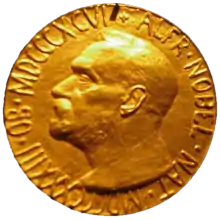
…to the person who shall have done the most or the best work for fraternity between nations, for the abolition or reduction of standing armies and for the holding and promotion of peace congresses. ~ Alfred Nobel
The Norwegian Nobel Committee (Norwegian: Den norske Nobelkomité) selects the recipients of the Nobel Peace Prize each year on behalf of Swedish industrialist Alfred Nobel's estate, based on instructions of Nobel's will, which states it should go "…to the person who shall have done the most or the best work for fraternity between nations, for the abolition or reduction of standing armies and for the holding and promotion of peace congresses."
Quotes
- The Norwegian Nobel Committee has decided to award the Nobel Peace Prize for 2021 to Maria Ressa and Dmitry Muratov for their efforts to safeguard freedom of expression, which is a precondition for democracy and lasting peace. Ms Ressa and Mr Muratov are receiving the Peace Prize for their courageous fight for freedom of expression in the Philippines and Russia. At the same time, they are representatives of all journalists who stand up for this ideal in a world in which democracy and freedom of the press face increasingly adverse conditions.
The Nobel Peace Prize 2020

As the UN’s largest specialised agency, the World Food Programme is a modern version of the peace congresses that the Nobel Peace Prize is intended to promote.
The work of the World Food Programme to the benefit of humankind is an endeavour that all the nations of the world should be able to endorse and support.
The work of the World Food Programme to the benefit of humankind is an endeavour that all the nations of the world should be able to endorse and support.
- The need for international solidarity and multilateral cooperation is more conspicuous than ever. The Norwegian Nobel Committee has decided to award the Nobel Peace Prize for 2020 to the World Food Programme (WFP) for its efforts to combat hunger, for its contribution to bettering conditions for peace in conflict-affected areas and for acting as a driving force in efforts to prevent the use of hunger as a weapon of war and conflict.
The World Food Programme is the world’s largest humanitarian organisation addressing hunger and promoting food security. In 2019, the WFP provided assistance to close to 100 million people in 88 countries who are victims of acute food insecurity and hunger.
- The coronavirus pandemic has contributed to a strong upsurge in the number of victims of hunger in the world. In countries such as Yemen, the Democratic Republic of Congo, Nigeria, South Sudan and Burkina Faso, the combination of violent conflict and the pandemic has led to a dramatic rise in the number of people living on the brink of starvation. In the face of the pandemic, the World Food Programme has demonstrated an impressive ability to intensify its efforts. As the organisation itself has stated, “Until the day we have a medical vaccine, food is the best vaccine against chaos.”
- The World Food Programme plays a key role in multilateral cooperation on making food security an instrument of peace, and has made a strong contribution towards mobilising UN Member States to combat the use of hunger as a weapon of war and conflict. The organisation contributes daily to advancing the fraternity of nations referred to in Alfred Nobel’s will. As the UN’s largest specialised agency, the World Food Programme is a modern version of the peace congresses that the Nobel Peace Prize is intended to promote.
The work of the World Food Programme to the benefit of humankind is an endeavour that all the nations of the world should be able to endorse and support.
Nobel Peace Prize for 2022

The Peace Prize laureates represent civil society in their home countries. They have for many years promoted the right to criticise power and protect the fundamental rights of citizens.
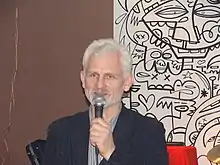
Ales Bialiatski was one of the initiators of the democracy movement that emerged in Belarus in the mid-1980s. … Government authorities have repeatedly sought to silence Ales Bialiatski. … He is still detained without trial.

The Center for Civil Liberties was founded in Kyiv in 2007 for the purpose of advancing human rights and democracy in Ukraine.
- The Peace Prize laureates represent civil society in their home countries. They have for many years promoted the right to criticise power and protect the fundamental rights of citizens. They have made an outstanding effort to document war crimes, human right abuses and the abuse of power. Together they demonstrate the significance of civil society for peace and democracy.
This year’s Peace Prize is awarded to human rights advocate Ales Bialiatski from Belarus, the Russian human rights organisation Memorial and the Ukrainian human rights organisation Center for Civil Liberties.
- Ales Bialiatski was one of the initiators of the democracy movement that emerged in Belarus in the mid-1980s. He has devoted his life to promoting democracy and peaceful development in his home country. Among other things, he founded the organisation Viasna (Spring) in 1996 in response to the controversial constitutional amendments that gave the president dictatorial powers and that triggered widespread demonstrations. Viasna provided support for the jailed demonstrators and their families. In the years that followed, Viasna evolved into a broad-based human rights organisation that documented and protested against the authorities’ use of torture against political prisoners.
Government authorities have repeatedly sought to silence Ales Bialiatski. He was imprisoned from 2011 to 2014. Following large-scale demonstrations against the regime in 2020, he was again arrested. He is still detained without trial. Despite tremendous personal hardship, Mr Bialiatski has not yielded an inch in his fight for human rights and democracy in Belarus.
- The human rights organisation Memorial was established in 1987 by human rights activists in the former Soviet Union who wanted to ensure that the victims of the communist regime’s oppression would never be forgotten. Nobel Peace Prize laureate Andrei Sakharov and human rights advocate Svetlana Gannushkina were among the founders. Memorial is based on the notion that confronting past crimes is essential in preventing new ones.
After the collapse of the Soviet Union, Memorial grew to become the largest human rights organisation in Russia. In addition to establishing a centre of documentation on victims of the Stalinist era, Memorial compiled and systematised information on political oppression and human rights violations in Russia. Memorial became the most authoritative source of information on political prisoners in Russian detention facilities. The organisation has also been standing at the forefront of efforts to combat militarism and promote human rights and government based on rule of law.
- When civil society must give way to autocracy and dictatorship, peace is often the next victim. During the Chechen wars, Memorial gathered and verified information on abuses and war crimes perpetrated on the civilian population by Russian and pro-Russian forces. In 2009, the head of Memorial’s branch in Chechnya, Natalia Estemirova, was killed because of this work.
Civil society actors in Russia have been subjected to threats, imprisonment, disappearance and murder for many years.
- The Center for Civil Liberties was founded in Kyiv in 2007 for the purpose of advancing human rights and democracy in Ukraine. The center has taken a stand to strengthen Ukrainian civil society and pressure the authorities to make Ukraine a full-fledged democracy. To develop Ukraine into a state governed by rule of law, Center for Civil Liberties has actively advocated that Ukraine become affiliated with the International Criminal Court.
After Russia’s invasion of Ukraine in February 2022, Center for Civil Liberties has engaged in efforts to identify and document Russian war crimes against the Ukrainian civilian population. In collaboration with international partners, the center is playing a pioneering role with a view to holding the guilty parties accountable for their crimes.
- By awarding the Nobel Peace Prize for 2022 to Ales Bialiatski, Memorial and the Center for Civil Liberties, the Norwegian Nobel Committee wishes to honour three outstanding champions of human rights, democracy and peaceful co-existence in the neighbour countries Belarus, Russia and Ukraine. Through their consistent efforts in favour of humanist values, anti-militarism and principles of law, this year’s laureates have revitalised and honoured Alfred Nobel’s vision of peace and fraternity between nations — a vision most needed in the world today.
External links
This article is issued from Wikiquote. The text is licensed under Creative Commons - Attribution - Sharealike. Additional terms may apply for the media files.