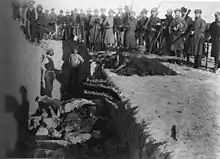
When they laid down their arms, we murdered them. We lied to them. We cheated them out of their lands. We starved them into signing fraudulent agreements that we called treaties which we never kept. We turned them into beggars on a continent that gave life for as long as life can remember. And by any interpretation of history, however twisted, we did not do right. We were not lawful nor were we just in what we did. For them, we do not have to restore these people, we do not have to live up to some agreements, because it is given to us by virtue of our power to attack the rights of others, to take their property, to take their lives when they are trying to defend their land and liberty, and to make their virtues a crime and our own vices virtues. ~ Marlon Brando
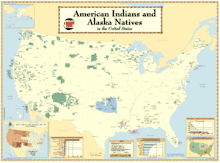
The listed Indian entities are acknowledged to have the immunities and privileges available to federally recognized Indian Tribes by virtue of their government-to-government relationship with the United States as well as the responsibilities, powers, limitations, and obligations of such Tribes. ~ Federal Register
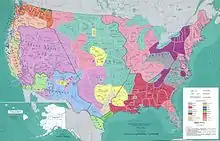
The whites have driven us from the sea to the lakes. We can go no further... unless every tribe unanimously combines to give a check to the ambition and avarice of the whites they will soon conquer us apart and disunited and we will be driven from our native country and scattered as autumn leaves before the wind. ~ Tecumseh


After millennia of Native history, and centuries of displacement and dispossession, acknowledging original Indigenous inhabitants is complex. Many places in the Americas have been home to different Native Nations over time, and many Indigenous people no longer live on lands to which they have ancestral ties. Even so, Native Nations, communities, families, and individuals today sustain their sense of belonging to ancestral homelands and protect these connections through Indigenous languages, oral traditions, ceremonies, and other forms of cultural expression. ~ National Museum of the American Indian
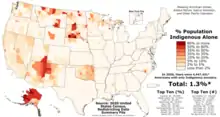
Native Americans in the United States, also known as First Americans, Indigenous Americans, American Indians, and other terms, are the Indigenous peoples of the United States, including Hawaii and territories of the United States.
"Native Americans" (as defined by the United States Census) are Indigenous tribes that are originally from the contiguous United States, along with Alaska Natives. There are 574 federally recognized tribes living within the US, about half of which are associated with Indian reservations. Indigenous peoples of the United States who are not American Indian or Alaska Native include Native Hawaiians, Samoans, and Chamorros, the US Census groups these peoples as "Native Hawaiian and other Pacific Islander".
Quotes
- When they laid down their arms, we murdered them. We lied to them. We cheated them out of their lands. We starved them into signing fraudulent agreements that we called treaties which we never kept. We turned them into beggars on a continent that gave life for as long as life can remember. And by any interpretation of history, however twisted, we did not do right. We were not lawful nor were we just in what we did. For them, we do not have to restore these people, we do not have to live up to some agreements, because it is given to us by virtue of our power to attack the rights of others, to take their property, to take their lives when they are trying to defend their land and liberty, and to make their virtues a crime and our own vices virtues.
But there is one thing which is beyond the reach of this perversity and that is the tremendous verdict of history. And history will surely judge us. But do we care? What kind of moral schizophrenia is it that allows us to shout at the top of our national voice for all the world to hear that we live up to our commitment when every page of history and when all the thirsty, starving, humiliating days and nights of the last 100 years in the lives of the American Indian contradict that voice?- Marlon Brando, Undelivered speech for the Academy Awards written by Brando as it appeared in The New York Times (March 30, 1973)
- [T]he motion picture community has been as responsible as any for degrading the Indian and making a mockery of his character, describing his as savage, hostile and evil. It's hard enough for children to grow up in this world. When Indian children watch television, and they watch films, and when they see their race depicted as they are in films, their minds be-come injured in ways we can never know.
- Marlon Brando, Undelivered speech for the Academy Awards written by Brando as it appeared in The New York Times (March 30, 1973)
- After the Ghost Dance spread across the Rockies to the Plains tribes it ran amok. ...The fervor attacked the Plains tribes virulently, particularly the Sioux, who were at that time the largest and the most intransigent of them all. The Sioux had been forced to submit to a series of land grabs and to indignities that are almost unbelievable when read about today. ...they were being systematically starved into submission—by the White Bureaucracy—on the little that was left of their reservation in South Dakota. ...From Rosebud, the Ghost Dance spread like prairie fire to the Pine Ridge Sioux and finally to Sitting Bull's people at Standing Rock. The Sioux rebelled; the result was the death of Sitting Bull and the massacre of the Indians (despite their ghost shirts) at Wounded Knee in 1890.
- Peter Farb, Man's Rise to Civilization (1968).
- To aid in identifying Tribal name changes and corrections, the Tribe’s previously listed or former name is included in parentheses after the correct current Tribal name. We will continue to list the Tribe’s former or previously listed name for several years before dropping the former or previously listed name from the list.
The listed Indian entities are acknowledged to have the immunities and privileges available to federally recognized Indian Tribes by virtue of their government-to-government relationship with the United States as well as the responsibilities, powers, limitations, and obligations of such Tribes. We have continued the practice of listing the Alaska Native entities separately for the purpose of facilitating identification of them.- Federal Register / Vol. 85, No. 20 / Thursday, January 30, 2020 / Notices, DEPARTMENT OF THE INTERIOR, “Bureau of Indian Affairs Indian Entities Recognized by and Eligible To Receive Services From the United States Bureau of Indian Affairs”, p.1
- I remember watching 7th and 8th grade kids improve in reading. Their "lives" depended on it.
The reaction of the faculty at the school was not so positive. I heard from Paul that we needed to eliminate any negative references to Native Americans. Since my generation had grown up on TV cowboy shows, my first reaction was that we were denying a piece of our own history. But upon reconsidering, I realized how powerful this game was in terms of immersing students into history. If any students of Native American ancestry played the game (and I'm sure there were plenty), they would be put in the position of constantly battling themselves. So we replaced "Indians ahead" with "riders ahead." Also, we replaced "tomahawked" with "knifed."- Bill Heineman as quoted by, Wong, Kevin (2017-02-15). "The Forgotten History of 'The Oregon Trail,' As Told By Its Creators". Motherboard. Vice. Archived from the original on 2018-09-01. Retrieved 2018-08-31.
- I will follow the white man's trail. I will make him my friend, but I will not bend my back to his burdens. I will be cunning as a coyote. I will ask him to help me understand his ways, then I will prepare the way for my children, and their children. The Great Spirit has shown me—a day will come when they will outrun the white man in his own shoes.
- Many Horses, also known as Rising Wolf, a holy man of the Oglala Lakota tribe who organized a Ghost Dance ritual at Standing Rock Reservation in 1890. "Rising Wolf -- Ghost Dancer" by Hamlin Garland. McClure's, 1899.
- "People were making money off of that racism of the Hollywood Indian. Of course, they're going to boo. They don't want their evening interrupted."
Littlefeather said she was escorted offstage at the Oscars by a team of security guards. She said that for years Hollywood boycotted her, calling it being red listed.- Sacheen Littlefeather as quoted by NPR, “Sacheen Littlefeather, who gave Marlon Brando's Oscar rejection speech, dies at 75”, NPR, (October 3, 2022)
- After millennia of Native history, and centuries of displacement and dispossession, acknowledging original Indigenous inhabitants is complex. Many places in the Americas have been home to different Native Nations over time, and many Indigenous people no longer live on lands to which they have ancestral ties. Even so, Native Nations, communities, families, and individuals today sustain their sense of belonging to ancestral homelands and protect these connections through Indigenous languages, oral traditions, ceremonies, and other forms of cultural expression.
- When reading old accounts Rawitsch was surprised by just how often Native tribes intervened to offer assistance to travelers that were struggling along the trail. This was something he hoped he could insert into the game to combat the negative stereotypes that were prevalent at the time in other media.
“We were very concerned about the way Native Americans were portrayed, because the schools that we taught in had significant populations of Native American students. In the diaries I read I probably should admit to being surprised by how often people wrote about the help they received from Native Americans who helped them understand where the trail was, where it went, what kind of food along the way was edible and which would make you ill.”
This manifested itself in the game as a new event that could occur when players were struggling. Native Americans would approach the party and offer help by sharing food or supplies with the settlers.- Dan Rawitsh as quoted by Yarwood, Jack (2015-10-22). "The Making of The Oregon Trail: An Interview with Don Rawitsch". Paste. Wolfgang's. Archived from the original on 2018-09-01. Retrieved 2018-08-31.
- When the white man landed on the shores of the New World, an eclipse, blacker than any that ever darkened the sun, blighted the hopes and happiness of the native people, races then living in tranquility upon their own soil.
- Eli S. Ricker, Voices of the American West, page xi
- While growing up on an Indian reservation in the Midwestern United States, I observed that fellow Indians loved western movies and paperbacks. Subsequently, I observed this phenomenon on Indian reservations in Oregon and North Dakota, as well as among Indians who lived off the reservations.
- JoEllen Shively, “Cowboys and Indians: Perceptions of Western Films Among American Indians and Anglos”, American Sociological Review, Vol. 57, No. 6 (Dec., 1992), pp. 725
- I hardly sustain myself beneath the weight of white men's blood that I have shed. The whites provoked the war; their injustices, their indignities to our families, the cruel, unheard of and wholly unprovoked massacre at Fort Lyon … shook all the veins which bind and support me. I rose, tomahawk in hand, and I have done all the hurt to the whites that I could.
- Sitting Bull, recorded by the Jesuit priest Pierre-Jean De Smet after a council with Sitting Bull on June 19,1868. Published in Utley, Robert M. The Lance and the Shield. New York: Henry Holt and Co., 1993. p. 79-80.
- Because I am a red man. If the Great Spirit had desired me to be a white man he would have made me so in the first place. He put in your heart certain wishes and plans; in my heart he put other and different desires. Each man is good in the sight of the Great Spirit. It is not necessary, that eagles should be crows.
- Sitting Bull, quoted in Vine Deloria, God Is Red: A Native View of Religion. Golden, Colo: Fulcrum Pub, 2003, cited to Virginia Armstrong, I have spoken; American history through the voices of the Indians. Chicago, Sage Books, 1971.
- The whites have driven us from the sea to the lakes. We can go no further... unless every tribe unanimously combines to give a check to the ambition and avarice of the whites they will soon conquer us apart and disunited and we will be driven from our native country and scattered as autumn leaves before the wind.
- Tecumseh, quoted in Seeking a Nation Within a Nation, CBC Canada.
External links
This article is issued from Wikiquote. The text is licensed under Creative Commons - Attribution - Sharealike. Additional terms may apply for the media files.