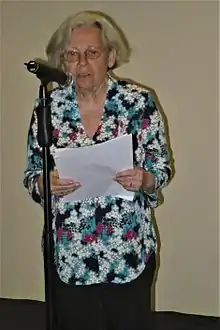
Irena Klepfisz in 2017
Irena Klepfisz (born April 17, 1941) is a Jewish lesbian feminist author, poet, academic and activist living in the US.
Quotes
- I feel a sense of urgency when it comes to Trump and his administration. I’m here today because I’m beginning to see what my parents saw in the 1930s in Europe. I always tried to imagined how it was like for them, but this is the first time in my life when I feel that I’m experiencing something similar. It has enormous echos for me. ‘America First’ is not substantially different from ‘Deutschland über Alles.’ One of the things that scares me is the global rise of right-wing movements in the United States, Europe and Israel. The American alt-right is in dialogue with similar movements in Israel, and this might pose a danger to both Israelis and Americans.
- Interview with Haaretz (2017)
Dreams of an Insomniac: Jewish Feminist Essays, Speeches and Diatribes (1990)
Preface
- no theory about American Jews has been able to express quite as well the nature and power of Jewish identity as the moment when I realized I had passed without a second thought a group of homeless people on a New York City street because I was rushing to a Jewish women's vigil protesting Israeli policies against Palestinians in the Occupied Territories. I saw myself instinctively redefining geography and distance, experiencing how much closer Israel, the West Bank and Gaza felt than the 59th Street stop of the Lexington line. Moments like these, integral parts of our daily lives, simultaneously embody theory and concrete experience and I continue to trust them most.
- Unlike poetry, essays have never felt natural.
- From the age of twenty, my ego has been invested in poetry. For me, the prospect of expression through poetry transforms solitary silence and an empty page into sheer pleasure. I feel unafraid, knowing I can break all the rules, invent my own forms. No matter what persona I take on, my voice remains accessible and recognizable. There is no artifice, no pose, no sense that I have to transform myself into someone else. As a poet, I remain comfortably disrespectful. I experiment, take risks which sometimes work and sometimes don't. For years I have had no such courage in essay writing. It has seemed an iron-clad genre that I could neither escape nor fit into.
- di bavegung, "the movement," has pushed, encouraged, and given me space, like it has to many women who lacked confidence in their skills and in the value of their perspectives. Above all, it challenged me to present publicly what I discuss privately, to raise issues that I care about and that are central to my experience as a feminist and lesbian, as a Jew sorting out my identity and my relationship to Jewish history, as an American Jew defining my relationship to events in the Middle East.
- At thirteen I tried silence. At sixteen I tried anonymity. I have since learned these are not the only options.
"Resisting and surviving America" (1982)
- As a child, my first conscious feeling about being Jewish was that it was dangerous, something to be hidden.
- As I grew older, I learned the full breadth of Yiddish literature; but this early introduction with its inherent political vision became as powerful an influence in my life as did the war.
- Experience has obviously taught me that Jews are not the only ones in danger and that what is "undesirable" in me is not limited to my Jewishness.
- As a writer I still cherish poetry that tells a story, especially the dramatic monologue. I still value most a poetry that deals with people, especially those alienated and out of the mainstream-the overworked and dreamless, Third World, women, gay-a subdued, earnest poetry that expresses their feelings, their struggles, the conditions of their lives.
- the Holocaust. I find it almost impossible to write that word because here-in America-the word has lost almost all meaning. And the fault lies with both non-Jews and Jews. It lies with the "American way of life," with the process of Americanization, with American Big Business, with commercialism, with posing, with artificial feelings.
- Yet despite this "turn off," I find-and am repeatedly stunned by it-that people (including non-Jews) insist on dredging it up. Writers, for example, who have no feelings or connection to the war, insist on it as literary metaphor, as an epigraph, as some kind of necessary addition. A casual allusion to Auschwitz. An oblique reference to the Warsaw Ghetto. Somehow this "sprinkling" of Jewish experiences is thought to reflect sensitivity, a largeness of heart. And of course it does not. It is simply the literary Holocaust, the Holocaust of words that has nothing to do with fact. It is nothing more than a pose. I must say that my teeth grind whenever I see these gratuitous gestures-usually devoid of any Jewish context, devoid of any sense of the Jewish experience or history.
- I've been thinking a lot about it lately, about the corruption here in America, how everything becomes big business, how everything becomes diseased. Everything.
- How can I say to people that for the survivors with whom I grew up the Holocaust never ended? That all my life I will feel the loss of never having known my father, never even having a photograph of him after the age of seventeen. That all my life I will feel the loss of aunts and cousins and grandparents I never knew. That my mother still stacks shelves and shelves of food-just in case. That twenty years after the war, when some plaster fell down from the living room ceiling, she froze with fear because she thought we were being bombed.
- The Holocaust was not an event that ended in 1945-at least not for the survivors. Not for me. It continued on and on because my mother and I were alone.
- This is the confusion. Being Jewish. Being a lesbian. Being an American. It all converges. It is like feelings about one's parents. Love and embarrassment. The painful realization that they are not perfect.
- When it comes to the bottom line, the Moral Majority is Christian. So is the Ku Klux Klan. So is the Nazi Party. And I am completely stymied that large segments of the Jewish population have not absorbed these simple basic facts.
- I am also angry that Jews have somehow, during this process, gotten stuck-I'm not sure if that's the right word, but I don't know how else to express it. They have been unable to absorb the experience of the Holocaust, have not learned how to transcend the catastrophe. They've mistakenly thought that to transcend means to forget the past, that to think about the present is to abandon the past. That too is a painful mistake, a grave mistake for Jews in America, because it's kept many of them from universalizing their experience, from joining with others who have experienced oppression-not perhaps an exact duplication of Jewish oppression, but nevertheless oppression.
- This is the confusion. Being Jewish. Being a lesbian. Being an Ameri-can. It all converges. It is like feelings about one's parents. Love and embarrassment. The painful realization that they are not perfect.
- When it comes to the bottom line, the Moral Majority is Christian. So is the Ku Klux Klan. So is the Nazi Party. And I am completely stymied that large segments of the Jewish population have not absorbed these simple basic facts.
- I am also angry that Jews have somehow, during this process, gotten stuck-I'm not sure if that's the right word, but I don't know how else to express it. They have been unable to absorb the experience of the Holocaust, have not learned how to transcend the catastrophe. They've mistakenly thought that to transcend means to forget the past, that to think about the present is to abandon the past. That too is a painful mistake, a grave mistake for Jews in America, because it's kept many of them from universalizing their experience, from joining with others who have experienced oppression-not perhaps an exact duplication of Jewish oppression, but nevertheless oppression.
- This is perhaps the most painful aspect for me of being Jewish, for I identify strongly as a Jew, am proud to be a Jew. And yet I sometimes feel so torn-so torn from the Jewish community, from the Jews I grew up with, who nurtured me, helped me. And yet I don't understand what America has done to them and how it has seduced them. The conservatism is there and really hard to accept. But it is there, definitely there with the mainstreaming.
- what the Jewish lesbian encounters are the typical conservative stances. Closed doors. Silence. Disgust.
- Those of the Left, Jew and non-Jew alike, seem to believe what the Right has always maintained-that Jews run the world and are, therefore, most responsible for its ills. The casualness, the indifference with which the Left accepts this anti-Semitic stance enrages me. It is usually subtle, often taking the form of anti-Semitism by omission. Its form is to show or speak about Jews only as oppressors, never as anything else. That is anti-Semitic.
- I cannot end without affirming as strongly as I can my deep feelings of identification and pride in being a Jew. It was Jews who first instilled in me the meaning of oppression and its consequences. It was Jews who first taught me about socialism, class, racism and what in the fifties was called "injustice." It is from Jews that I adopted ideals that I still hold and principles that I still believe are true and must be fought for and put into practice. It was from Jews that I learned about the necessity for resistance. It was from Jews that I also learned that literature is not simply fancy words or clever metaphor, but instead is deeply, intimately connected to life, to a life that I am a part of. It is really almost impossible to compress this inheritance into a single paragraph. But I know its depth and vitality, and I know that I have absorbed it thoroughly into my
consciousness.
- I write as much out of a Jewish consciousness as I do out of a lesbian/feminist consciousness. They are both always there, no matter what topic I might be working on. They are embedded in my writing, embedded and enmeshed to the point that they are not necessarily distinguishable as discrete elements. They merge and blend and blur, for in many ways they are the same.
"Jewish Progressives and the Jewish Community" (1988)
- I do not accept the assumption that there exist two distinct Jewish worlds-progressive and mainstream (or traditional)-all of whose values and norms are always in conflict. My experience as a feminist and a lesbian is that the Jewish world we call progressive has been often as slow and reluctant to deal with feminist and gay issues as the mainstream Jewish world. Some advances have been made and many, though not all, Jewish progressives have reached the stage of paying obligatory lipservice and ensuring token representation at progressive events. But a clear-cut commitment to fighting sexism and homophobia and a dedication to gaining full rights for gays have not evoked the same passions which the struggles for rights of other minorities evoke. Most Jewish feminists and gays that I know remain angry and frustrated by Jewish progressives. Deeply committed to progressive causes, frequently in the vanguard of political action, Jewish feminists and gays find ourselves fighting for the rights of others without the secure knowledge that others will fight for us. Most of the time we fight sexist and heterosexist battles alone in both these worlds.
- Perhaps this experience as a lesbian and feminist is the reason I try to avoid the "us" and "them" division and try to find common ground in both worlds from which to launch various battles. The "us" and "them" division-"us" meaning progressives and "them" being the mainstream-is too simple and veils a more complex reality. It also smacks of smugness and self-righteousness, which I find alienating. It assumes that the progressive world has everything to offer the mainstream and the mainstream's main activity is to unlearn its evil ways. This is neither useful nor accurate. I am, for example, often pained by the ignorance of many Jewish progressives in relation to Jewish history, culture, and religion and wish we would have more contact with the mainstream community and get our Jewishness on firmer ground.
- there needs to be greater communication between Jewish progressives and the Jewish mainstream, there needs to be an exchange, bartering if you will. If such exchanges do not take place we will still be progressives, but not Jewish progressives.
- There needs to be among us a greater sense of an exchange between equals rather than between givers and receivers. If this sense of mutual respect does not exist, then we progressives will surely be forever seen as outsiders.
- As a feminist and lesbian, as a Yiddishist and a cultural Jew, I often feel alienated from Jewish progressives who do not share my cultural concerns, who do not worry about Jewish cultural survival... I have found, in fact, that my concerns about Jewish identity and culture often form the bridge to the mainstream Jewish community and enable me to get progressive issues such as women's and gay and lesbian rights a more sympathetic ear.
- We Jews are living in a strange historical period in which our sense of history is often quite warped. For many American Jews, the Holocaust and Israel have reduced Jewish history to the years 1939-1945, or 1948 to the present. This extremely limited view of Jewish history naturally narrows the concept of Jewish identity and that narrowness is one which we as progressives ought to be countering.
- Let us not take the attitude that because of our politics we must remain pure and not mix with the Jewish rabble-the mainstream. Let us be as willing to meet with Jews in small community centers in our neighborhoods as we are to meet with Palestinians. The work to be done at these centers and synagogues is as critical as the work needed to resolve the Palestinian/Israeli conflict.
Interview with Yiddish Book Center (2017)
- I have to confess that one of the things that I'm thinking a great deal about -- my mother just died a year ago in March. She would have been -- she was four months short of her 102nd birthday. And one of the things, of course -- I think this happens with everyone -- is you start really regretting what you didn't ask and what you didn't find out. And I'm sort of thinking a great deal about that right now -- I mean, in the last few months -- especially with the trip to Poland. So, I don't know totally, but it was not -- it was very much her -- I mean, the fact that she had to go to work at the age of twelve and that she went to night school and she was actually very interested in literature and was -- she worked in the library. She was a volunteer in the library; I don't think she got paid. She was always a big reader, and she passed that on to me.
- The family was very apparently politically diverse. My mother was originally in the Hashomer Hatzair movement. She even went on one of these outings where she learned how to raise tobacco when she -- if she were to go to Palestine. So, there were a couple of Zionists, there were a couple of communists, and there were a couple of Bundists. And my -- after she met my father, she turned into the Bundist. So, I -- but apparently, there were some tensions among all the in-laws around these politics, so it was sort of an interesting -- sounds like a really interesting family.
- My mother had very -- a lot of very different names. She was -- I think her Hebrew name was Shoshana, which means "rose," and in Polish, that's Róża. In Yiddish, that would be Rushke. During the war, she acquired the name of Lodzia -- that was her Aryan name. And a lot of people kept their Aryan names after the war, neither using their Polish or their Yiddish names.
- One of the places I wanted to go this time to -- when I was in Poland was Zakopane, because my parents met in Zakopane. Zakopane was a kind of resort, and a lot of the people went camping there and skiing in the winter and mountain climbing in the summer and that kind of thing. And the Bund had outings there. And I don't know whether she was there with a Zionist thing and he was there with the Bundists, but they met skiing one winter, apparently. And they had, like, a four-year courtship. And they got married on her birthday, in 1937. And that was the beginning. And he was still in engineering school -- he was still studying. He hadn't completed his studies at the Polytechnic. And that was sort of the story of their marriage.
- The Jewish Labor Bund began as a kind of socialist movement aimed at Jewish workers and evolved into -- very quickly, actually -- it evolved into a kind of socialist, self-consciously culturally identified movement, so that they weren't just -- that it wasn't only interested -- or understood that just either having better wages or better working conditions was really not enough, and that people needed schools and libraries and sports organizations and theater and art and literature in order to lead a kind of enriched life. So, it's not a typical kind of just socialist -- you know, kind of union organizing movement the way I perceive it.
- I grew up among Holocaust Bundist survivors, so I heard a lot of talk about what their life was like before the war.
- I used to tell the story that when I first came to the States and I moved into this working c-- we moved into this working-class Jewish, very, very Jewish neighborhood, but when Friday night came and my girlfriends would suddenly say, Oh, look, there's a star and we have to stop playing, I have to go home, I just didn't understand it. I just thought -- I really thought they were fake Jews, because you had to be a Yiddishist, a socialist -- (laughs) I don't know, in order to be -- those were the authentic Jews, to me. And that was partly because that's all I ever knew, really, and all of this other stuff was just very strange and alien. So, that's sort of the Bund, to me. The Bund is sort of everything. It's the stuff you read. It's the stuff -- it's your politics. It is -- a lot of it is political in the sense of a socialist belief in economic equality and other kinds of equalities. But it's also a lot beyond that, as well.
- I was born in Warsaw during the war. And I was -- survived partly because I was hidden in a place in a Catholic orphanage. And my parents arranged for that. My father was killed in the uprising. He was one of the people involved in the uprising -- in organizing it.
- I decided this last year that I wanted a memorial to my mother's family and my father's family, because there was nothing. And so, I was able -- because you can't put up new stones there, but they gave me permission to put, like, a plaque on the foot of my father's stone, and I put down all the names of my father's family and all the names of my mother's family. So, I'm glad you made me say the names, because I think it's important.
- One of the things I think about -- or I've come to realize or I've thought about or thought through -- is that my mother must have been deeply depressed, I can't imagine that she wouldn't have been -- and that I really don't remember being affected by it, because I had an enormous amount of attention. I think children like me, who survived, were very rare, and we were really special.
- Sweden was Eden, and that's what it felt like. I was totally unaware of the Holocaust. I don't remember ever hearing about it; I don't remember any commemorations about it; I just -- I don't think I heard of the Holocaust until I came to the United States. I don't think I knew what it was or how I was in it or what my -- you know, what my connection to it was. I didn't -- never heard of it till I came here. And by then, I was eight, so that was pretty late.
- We came to the United States and my mother and I shared a one-bedroom apartment with somebody who didn't like kids, and we lived in the living -- you know, living room -- and it was very bleak. And I have to say, I didn't find the Jewish kids that I sudden-- I was the only Jew in Sweden, in my Swedish school, and I had no problems, but when I came here, I had real problems from other Jewish kids, being a -- you know, a greenhorn or whatever. My mother dressed me funny: I had funny braids, I had funny stockings, I had funny hair bows. I mean -- (laughs) I wasn't pleased. And I'm -- it was a big trauma for me to -- I mean, I always considered coming here more of a trauma than anything else I had experienced up until then, which is probably not true, but it was certainly more conscious that I was very much wrenched from an environment that I really wanted and loved. And suddenly, I was a Holocaust survivor, which I didn't even know. And I was pointed to, and I was my fa-- I had no s-- I wasn't aware of any specialness in Sweden, and suddenly I was special 'cause I was Michał Klepfisz's daughter and -- and there were these terrible, frightening memorials. It wasn't much fun. It wasn't much fun.
- It wasn't an age in which people explained a lot of things to kids. Really. I mean, we're so careful now about, is this gonna traumatize the child and all of this. Nobody even thought about it.
- The daughter of a friend of mine was taking a course on bilingualism and trilingualism, and she had to write a paper, and she wanted to interview me because of sort of my linguistic background. And so, she said, "Well, how did you learn Swedish?" I said, "I don't know." And she said, "Well, did they -- did anybody tutor you?" I said, "No. They just stuck me in a Swedish class, and somehow I learned Swedish." (laughs) And then, we got to -- and she said, "Well, how did you learn English?" I said, "Well, they just put me in a classroom, and -- I learned Eng--" (laughs) And she was just dumbfounded, because, you know, now you have all these -- you know, second language, ESL, and all of that kind of stuff. And it's true; they just dumped you into an environment, and as a kid -- you know, kids do pick up very quickly. It's true. Up to a certain age. You know, Noam Chomsky says it's genetic, and it is, and you do pick it up.
- It was very frightening, you know, in those days. I've described this. First of all, there were hundreds and hundreds of survivors in the city, and they would come. And these meetings were -- these akademyes were very frightening to me. First of all, there were a lot of people with a lot of disabilities that I wasn't used to seeing. People with a lot of numbers on their arms, which I had begun to understand what it meant. And the talk from the podium was very -- (clears throat) very unguarded -- talked very much about tortures and camps and -- I mean, there were always performances of songs from the war years and ghetto lider [songs] and -- and always -- you didn't applaud because it wasn't a performance, it was a memorial. And at the same time, there would be people who were openly, openly just weeping out loud. I mean, to a nine-year-old, that's a pretty (laughs) scary scene, and mixed in with the fact that I wasn't there anonymously, even. I couldn't really even hide. It did not leave a great impression on me. I mean, it was very, very frightening. And it made me feel in some way that I was in great danger, in a way that I don't think I'd ever experienced before. And I think it was very destructive for me personally, and really traumatizing me for -- it took me a long time to get over it. And I reached a point -- when I was about fifteen -- the thing was, see, they always used me as a symbol for all the children that didn't die. I had to light a candle for the million and a half children that died. That was my job. And I don't think it was every year, but it was quite a few times. And one time, when I was standing on stage, they had the six people that were gonna light the candles, I don't know, something like that. Somebody said -- pointed at me and said, "She was snatched from the -- she was snatched from the ovens." And I almost fainted. I was, like, fifteen when they said that. I could barely keep standing. It really terrified me.
- I think my introduction to loving poetry and literature came from Yiddish
- The '50s were so culturally different than what -- anything that we have now. I mean, there was no bridge between that public school and that shule. In public school, we did Easter -- even though it was, like, ninety-eight percent Jewish, we did Easter, we did Christmas. There was not one mention of anything Jewish. And in the shule, it was like the rest of the world didn't exist.
- I think we were obnoxiously terrible, and teenagers, and I always feel very guilty, because one of the teachers, Khaver [Comrade] Kazhdan, was my father's teacher, and I think he was looking forward to teaching me, and I think he was gravely disappointed. And I always feel really, really bad, 'cause he was a lovely man. And, well, you don't -- you don't recognize lovely men at the age of fifteen.
- I had this really interesting experience in the '80s; I interviewed -- I don't know if you know who Alice Shalvi is. She's a major -- she's quite elderly now -- she's a major feminist in Israel, and I interviewed her in the '80s. And she said something when I -- after I finished the interview, she said, "You know, Klepfisz," she said, "that's very familiar." I said, "Oh, you know about my father." You know, I just -- I was, like, in my forties already. She said, "No, I never heard about your fa-- I never heard of your father." And she said, "Oh, I read your poem!" (laughs) It was, like, the first time that somebody who didn't know my father knew me.
- My mother continued always to speak to me in Polish. I never spoke Yiddish in the house. People always say I was a native Yiddish speaker; it's just not true.
- I started writing in high school. I was a terrible English student; it was my worst subject. But around sixteen, I became -- I had always been a reader, but at sixteen, something clicked in a way that it hadn't before, and it had much more meaning-- I don't know why I read before, but at sixteen, something happened that made me realize that what I was reading had some impact and meaning and -- and a world in a way that I hadn't before.
- English was very difficult for me, and I think it was all psychological. I think I didn't want to come here, I didn't want to learn another language. And it plagued me into graduate school. I mean, I just did not understand English grammar. But I also have to say that nobody took the trouble to sit down with me and really work on it, like, Why are you so terrible in this? And I think writing secretly and writing poetry was a way of just -- I did want to express myself, but I didn't want anybody to tell me it was wrong. I didn't want critiques. I didn't want anything -- I just wanted to be left alone. And that's when I started writing.
- One of the things that I always liked was, I sort of liked the kind of Yiddish poetry of like, Morris Rosenfeld. I liked somebody telling a story -- narrative. I liked narrative in poetry.
- When I got to high school, I was introduced to Robert Browning's sort of dramatic monologues,
- When I write, I will say it out loud to myself over and over again. I want to hear it. I want to hear how it sounds. Not only -- I like to manipulate it on the page and how it looks, but I also want to be able to hear it.
- I experienced a lot of homophobia when I came out, around 1974
- What happened was that Jewish feminists decided to either reclaim some stuff or -- they pushed into the Jewish community -- and people who had been outside of it, suddenly, women saw that there was a way in because of these other Jewish feminists.
- Every minority woman did this. They went back to their communities and they said, Where are the women? Let me see where they've been hidden, where they've been buried, who's forgotten, who should be remembered. We all did that with our own communities of origin, and I did the same thing with the Yiddish. And so, when I did with Melanie Kaye/Kantrowitz -- when we did "The Tribe of Dina," we highlighted Fradel Shtok, who I'd never heard of before, and Kadia Molodowsky, who I had, but I didn't even know that she wrote prose. And we published -- I translated two short stories by both of them. And aside, I think, from Rokhl Korn, it was, like, the first time that these people's prose was being shown.
- There's an enormous amount of protectiveness -- of sort of like, the three classic writers. You're not -- can't say that they were sexist. Why? I mean, why were they -- were they really, I mean, the only three men in the last century who were not sexist? It just doesn't make any sense.
- In the '80s, when I -- I've written about this -- I was rooming with Gloria Anzaldúa, who was a Chicana lesbian writer from Texas. And we were teaching in a program in Santa Cruz -- a summer three-week -- I think it was a three-week program. It was called Women's Voices, and it was about -- it was a writing program,...We sort of introduced ourselves to each other, and -- she did ask me how come I never used Yiddish, and I thought that was sort of an interesting (laughs) question, since it had never even occurred to me. I mean, I think I used two Yiddish words up until then.
- "At what point did Yiddish come into your writing?"
- I took my first trip to Poland; it was in '83; it was the fortieth anniversary of the Warsaw Ghetto Uprising. And I went with my mother -- the only time she returned. And that had a profound effect on me, also. I think that also pushed me more towards trying to reclaim a Yiddish legacy, because I was sort of very -- I was particularly moved by the cemeteries, which were -- the two larger cemeteries that I saw were in Łódź and in Warsaw. And that, I think, also pushed me, because in some ways, that trip and those cemeteries made very clear to me the Holocaust in a way that it hadn't been before. Because the tombstones reflected the life that had been sort of destroyed in a very concrete way. I mean, you -- it wasn't abstract words; it wasn't a photograph; it was -- these were really burial places of actual people and an actual life. And it was something -- I once said it was like looking at a negative -- instead of looking at the photograph, you're looking at the negative. And that was very profound.
- One of the things that I did when I went to Poland this summer was, I insisted that there were lesbian -- because I know what's going on over there -- that I insisted that the word "lesbian" be in my bio. And it was interesting -- in Kraków, three young people came up to me, one of them in tears, just ecstatic that I had done it, and that I actually -- I had talked about it.
- At the time, it was not an easy process to come out in the Jewish community. And very often, I voluntarily was a token. I mean, I knew I was being used as a token. But I think that that's also part of the process. I think you allow yourself to be a token just so often, you know. But I think it's part of a process of people getting adjusted and having a token out there that they can -- that makes it easier for somebody else not to be a token.
- I started going through "Doyeres bundistn," which is this three-volume -- you know, the translation is, I guess, "Generations of Bundists" -- of this -- incredible biographies of these people, and I started just looking at the women and who they were.
- I'm a person who's interested in history in general. I think we should have accurate history, and I think we should look at people that have been erased, histories that have been erased.
- I started looking for Yiddish -- for women Bundists and I started going through "Doyeres bundistn," I had one of those sort of Holocaust moments where I actually had to stop doing it. I don't know, I'd gone through maybe fifteen, twenty -- like, the first ones. I just did it alphabetically. I just -- Okay, here's a woman, and I'm gonna read about her. Here's the next one, and I'm gonna read -- I wasn't taking notes; I was just -- and it was incredible to me, reading them, the amount of energy that they had in establishing these schools, these libraries, these health centers, these children things. I was just -- to the point that -- and I knew they had been all killed. I mean, and I knew it had all been wiped out.
- The translation of Yiddish literature into English by the -- beginning with, like, Irving Howe, and that totally erased women, so it was even worse in English than it actually was in Yiddish.
- The Bund was always -- was very strongly, before the war, anti-Zionist, and I was raised -- I don't know if I was raised anti-Zionist, because already by the time I was conscious, Israel already existed and the Bund made its peace with the fact that there was an Israel, but I never had the Zionist idea that I was -- that my home was there. I always felt that my home was in Poland...I want to make sure that it gets remembered. I want to pass it on to other people.
- I felt that by translating, first of all, I made something accessible that was inaccessible and would remain inaccessible. And in some cases, it actually inspired other people to learn Yiddish, by reading the -- then they said, I want to read the original and I want to read more. What's not translated?...it's not like the real thing. It never is. But it's either you get this, or you get nothing. And I feel that a good translation -- it's not the original -- gives you a lot.
- I wish more stuff was available in English. I mean, I wish I could put stuff in my classroom. But I can't, unless it's translated. And then, that means that students remain ignorant of it.
Interview (2018)
- I only really became familiar with religious aspects of Judaism when I became active in the Women’s Movement, and I was forced into it. I was working with women who were observant, and I wanted to be sensitive, so I started learning. A friend and I did a feminist Haggadah. I have a whole bunch of xeroxed Haggadahs with all kinds of goddesses on them.
- I feel I was very lucky, though, because when I came out, which was in 1973, New York was just hopping. It was exploding. It was after Stonewall. Lesbians started getting organized. I belonged to a group of lesbian writers. There were four of us who decided to start Conditions magazine, for example, and before that we had a group called Di Vilde Chayas [the wild animals], which was a group that had Adrienne Rich, Melanie Kay Kantrowitz, Gloria Greenfield, and Evelyn Beck, who did Nice Jewish Girls.
- The Jewish Labor Bund was a non-Zionist organization, so I barely thought about Israel. But if you’re going to be involved with the Left, you’ve got to start thinking about Israel. Melanie and I became very committed to supporting the Women in Black in ‘87. I formed a group here, the Jewish Women’s Committee to End the Occupation (JWCEO) with Clare Kinberg and Grace Paley. We wanted to be identified as Jews protesting.
- When I published my first book, I had lesbian poems in there. Some people got it, and some people didn’t. There were people who only wanted to look at my Holocaust poetry. They pretended like there was nothing else. On the other hand, there were lots of lesbians who were just interested in my lesbian poems and could care less about the Holocaust ones. It was very difficult for me to give readings because I never had an integrated audience. It was only many years later, in the ‘90s, when I became better known and would be invited to campuses, for example, that my readings would be co-sponsored by an English department, a women’s center, and an LGBT committee or group. When I did these things, people would always say, ‘Gee, we’ve never had such a mixed audience before.’ In the ‘70s… this was still too raw. Some of it was quite ugly, and it was very disappointing for me to see the community that I had come out of be so bigoted.
- You’re sort of one person at one moment and another person at another moment. I suppose the only time that you’re ever really complete is when you’re by yourself or in an environment in which you’re not hiding. In the gay community, I was not hiding my Jewishness. Not everybody was interested in my Yiddish work, but nobody was hostile to it. But in the Jewish world, I had to be shut down in certain ways.
- I feel connected to Jewish history. I feel a part of the Jewish community, in all of its variety. As a Jew, my fate is bound up with other Jews. That could be Hasidim, Sephardim...people who are very different from me. In addition to that sense of bond and commitment, I also feel an obligation to contribute to Jewish culture, and that could take different forms. That could be my own writing, or it could be translations from Yiddish, so that people who don’t speak Yiddish can connect with Ashkenazi tradition. I don’t want Yiddish to disappear because nobody can read it. I also spend a lot of time on the Israeli-Palestinian conflict. I feel very much that it’s a part of me, in a way; I can’t totally distance myself from it, but I’m deeply disturbed by what’s happened there. I recognize the existence of religious texts, but I don’t necessarily believe them. I appreciate some of them from a literary or historical perspective, and I understand that they’re part of my history as a Jew, but I’m not moved by synagogue. I’m not even sentimental about it.
- "You write that you have always identified as a secular Jew. What does that mean to you?"
- There’s got to be a greater knowledge of diversity in Jewish life.
- I don’t think there is an ideal community—there are different kinds, and it shifts. One of the things we make a mistake about is that we want things to be static. You have to recognize when it’s become confining or rigid or prescriptive. You know, people always forget, Hasidim were considered rebels only 250 years ago. They were excommunicated! Everyone thinks they were around, walking in the desert in Palestine. They weren’t! They don’t realize that it’s much more dynamic. That gives me hope, that things change.
- I think there’s a strand of people who say you have to speak Yiddish, and you have to speak it correctly. I don’t want the movement to become elitist. It used to be that Hebrew was the loshon ha-kodesh [holy language]. I don’t want Yiddish to become a holy language. I want it to be of the people, which is the way that it always was. I think that’s something to guard against.
Interview with Forward (2019)
- Heroes: Grace Paley, Tillie Olsen, Shirley Chisholm — what a generation!
- One of the nice things I like to do is to get bilingual books, both in Yiddish and now in Polish...I have, like, poetry which is in Polish on one side and English on the other. And that's sort of an interesting way, also, for me to think about poetry and look at things.
- It seems to me that there are sort of multiple American Jewish identities. One is the Zionist identity -- that I'm a Jew because I'm a Zionist, and I don't have to do anything else, but I can support Israel and I'm a Jew. And then, there's the observant one -- the one that's -- you know, you go to the synagogue. And the secularists -- I mean, when my -- when I first wrote my essay, "Secular Jewish Identity: Yiddishkayt in America" in "Tribe of Dina," which was, like, in, I don't know, '83, '84, people came up to me and said, I didn't realize I was a secularist...there was also this other identity which had to do with the Holocaust, and it had to do with either identifying yourself as a survivor or identifying yourself as the first generation or second and now third, where your identity is Jewish because of your connection to the Holocaust.
- The arts, I think, are very affirming -- affirming, even when they're depressing.
- My students always -- when they want to talk about activism, are always worried that they're not -- you know, Well, we only have four or five people. And I tell them, "Don't worry about that." You know, four or five people can do a lot. And you don't know where you're gonna end up.
- I did teach, and I may start again next semester, for ten years at Bedford Hills Correctional Facility. And I always sort of considered that part of -- I don't know where the desire came to do that. It's something that I really love doing, and it -- you know, it made me see and opened up a whole part of sort of American justice system and society. But I felt it was very much in keeping sort of with my Bundist connection, even though it had nothing to do with Yiddish or Jews necessarily, or anything else. But it did have a lot to do with fairness and justice.
External links
This article is issued from Wikiquote. The text is licensed under Creative Commons - Attribution - Sharealike. Additional terms may apply for the media files.