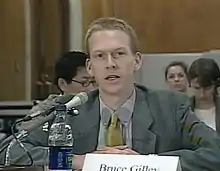
Bruce Gilley
Bruce Gilley (born July 21, 1966) is a professor of political science at Portland State University. His article "The Case for Colonialism", published in an advance online edition of Third World Quarterly in 2017, was highly controversial for its thesis. The outrage culminated in threats of violence which caused Gilley to agree to its retraction. Fifteen members of the journal's board resigned as a result of Gilley's article.
Quotes
- After I failed to win consideration for inclusion in the special issue, the Third World Quarterly editor Shahid Qadir sent my article for normal peer review. It received one positive and one negative review. Qadir, as was his prerogative, decided to run it but as a “viewpoint” rather than “research” article, with my consent.
- Research that is careful in conceptualizing and measuring controls, that establishes a feasible counterfactual, that includes multiple dimensions of costs and benefits weighted in some justified way, and that adheres to basic epistemic virtues often finds that at least some if not many or most episodes of Western colonialism were a net benefit, as the literature review by Juan and Pierskalla shows. Such works have found evidence for significant social, economic, and political gains under colonialism: expanded education, improved public health, the abolition of slavery, widened employment opportunities, improved administration, the creation of basic infrastructure, female rights, enfranchisement of untouchable or historically excluded communities, fair taxation, access to capital, the generation of historical and cultural knowledge, and national identify formation, to mention just a few dimensions.
- The Case for Colonialism: A Response to My Critics, Page 5 The case for colonialism, Gilley, 2017
- Eminent scholars repeatedly make the logically contradictory claim that colonialism was both too disruptive and not disruptive enough.
- The Case for Colonialism: A Response to My Critics, Page 5 The case for colonialism, Gilley, 2017
- Any claim about…the level of colonial violence, requires not just assumptions about the scale of violence that would have occurred absent colonial rule but also a careful measure of that violence relative to the population, security threat, and security resources in a given territory. One is hard-pressed, to take a prominent example, to find a single example of such care in measurement in the vast critical cholarship on the British counter-insurgency campaign against the Mau in Kenya from 1952 to 1960…At the very least, it is incumbent on scholars to show that the brutalities unleashed by the British in this campaign were not the likely result of a proportionate response given the context and scale of the threat. If this supposedly solid case is wobbly, what does it tell us about the lesser ‘violence’ often cited as invalidating colonialism?
- The Case for Colonialism: A Response to My Critics, Page 17-18 The case for colonialism, Gilley, 2017
- One main challenge of this research is to properly enumerate the things that matter and then to assign them weights, weights that presumably varied with time and place.
- The Case for Colonialism: A Response to My Critics, Page 17-18 The case for colonialism, Gilley, 2017
- Millions of people moved closer to areas of more intensive colonial rule, sent their children to colonial schools and hospitals, went beyond the call of duty in positions in colonial governments, reported crimes to colonial police, migrated from non-colonized to colonized areas, fought for colonial armies, and participated in colonial political processes – all relatively voluntary acts. Indeed, the rapid spread and persistence of Western colonialism with very little force relative to the populations and areas concerned is prima facie evidence of its acceptance by subject populations compared to the feasible alternatives... In most colonial areas, subject peoples either faced grave security threats from rival groups or they saw the benefits of being governed by a modernized and liberal state.
- The Case for Colonialism: A Response to My Critics, Page 23 The case for colonialism, Gilley, 2017
- At least in the initial phases, legitimacy will be demonstrated not by the holding of a plebiscite or by the support of organized and broadly representative groups but simply by the ability of the intervening state to win compliance from key actors and get the job done.
- The Case for Colonialism: A Response to My Critics, Page 29 The case for colonialism, Gilley, 2017
Quotes about Bruce Gilley
- Not only should we not accept Gilley’s general pro-colonial explanation of the poor performance of many post-colonial African nations since he provides us with no good reason to do so, we do have good reason to believe that their poor performance is a legacy of their colonial subjection.
- Whatever we think about Gilley’s article, then, the idea that colonialism can be summarized by reference to a gruesome picture of a Congolese peasant, a trite ‘what if it happened to you’ scenario, and the cheap trick of its ‘tantamount to’ holocaust denial is absurd.
- The Case for Colonialism: A Response to My Critics, Page 14 T. Young, 2019, p. 333
- The problem with Gilley’s case for colonialism is the lack of rigor, his inability or unwillingness to vigorously and transparently challenge his own beliefs, his own values and his own fears – in a word, his perspective.
- The Case for Colonialism: A Response to My Critics, Page 30 Rodriguez, 2018, p. 258
- He must be treated with utter disgust, with unsurpassed revulsion. He must be ostracized, publicly shamed and humiliated.
- The overwhelming consensus among our colleagues who are experts in history and political science that Gilley’s research is not merely unpopular but rather discredited.
- The Case for Colonialism: A Response to My Critics, Page 33 PSU-AAUP, 2021
External links
- Bruce Gilley publications indexed by Google Scholar
- Essays on "The case for colonialism". Portland State University. Retrieved on 2017-11-11.
- Video of lecture "The Case for Colonialism" at Texas Tech University, 2018. (text)
This article is issued from Wikiquote. The text is licensed under Creative Commons - Attribution - Sharealike. Additional terms may apply for the media files.