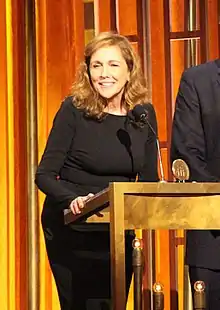
Druyan accepting Peabody Award in 2014 for Cosmos: A SpaceTime Odyssey
Ann Druyan (born June 13, 1949) is an American author and producer specializing in productions about cosmology and popular science. She was a co-writer of the 1980 PBS documentary series Cosmos, hosted by Carl Sagan whom she married in 1981. She is the creator/producer/writer of the follow-up Cosmos seasons: Cosmos: A Spacetime Odyssey and Cosmos: Possible Worlds.
She was in charge of music selections that were included with the pioneer spacecraft, Voyager 1 and Voyager 2.
Quotes
- It is a great tragedy that science, this wonderful process for finding out what is true, has ceded the spiritual uplift of its central revelations: the vastness of the universe, the immensity of time, the relatedness of all life, and life’s preciousness on our tiny planet.
- Ann Druyan interviewed by the Committee for Skeptical Inquiry. — "Ann Druyan Talks About Science, Religion, Wonder, Awe … and Carl Sagan". Skeptical Inquirer 27 (6). November–December 2003.
- When my husband died, because he was so famous and known for not being a believer, many people would come up to me-it still sometimes happens-and ask me if Carl changed at the end and converted to a belief in an afterlife. They also frequently ask me if I think I will see him again. Carl faced his death with unflagging courage and never sought refuge in illusions. The tragedy was that we knew we would never see each other again. I don't ever expect to be reunited with Carl. But, the great thing is that when we were together, for nearly twenty years, we lived with a vivid appreciation of how brief and precious life is. We never trivialized the meaning of death by pretending it was anything other than a final parting. Every single moment that we were alive and we were together was miraculous-not miraculous in the sense of inexplicable or supernatural. We knew we were beneficiaries of chance. . . . That pure chance could be so generous and so kind. . . . That we could find each other, as Carl wrote so beautifully in Cosmos, you know, in the vastness of space and the immensity of time. . . . That we could be together for twenty years. That is something which sustains me and it’s much more meaningful. . . . The way he treated me and the way I treated him, the way we took care of each other and our family, while he lived. That is so much more important than the idea I will see him someday. I don't think I'll ever see Carl again. But I saw him. We saw each other. We found each other in the cosmos, and that was wonderful.
- Ann Druyan interviewed by the Committee for Skeptical Inquiry. — "Ann Druyan Talks About Science, Religion, Wonder, Awe … and Carl Sagan". Skeptical Inquirer 27 (6). November–December 2003.
- I think the roots of this antagonism to science run very deep. They're ancient. We see them in Genesis, this first story, this founding myth of ours, in which the first humans are doomed and cursed eternally for asking a question, for partaking of the fruit of the "Tree of Knowledge". It's puzzling that Eden is synonymous with paradise when, if you think about it at all, it's more like a maximum-security prison with twenty-four hour surveillance. It's a horrible place. Adam and Eve have no childhood. They awaken full-grown. What is a human being without a childhood? Our long childhood is a critical feature of our species. It differentiates us, to a degree, from most other species. We take a longer time to mature. We depend upon these formative years and the social fabric to learn many of the things we need to know.
- Ann Druyan interviewed by the Committee for Skeptical Inquiry. — "Ann Druyan Talks About Science, Religion, Wonder, Awe … and Carl Sagan". Skeptical Inquirer 27 (6). November–December 2003.
- I really believe that the marijuana laws are a terrible injustice. They make no sense scientifically, ethically, legally, or any way. They cost a fortune to enforce and we incarcerate hundreds of thousands of people who have done nothing else, but possess or distribute marijuana. Maybe it's because I'm a child of the 60's and marijuana has been such a positive part of my life. I have never seen it as being addictive, having spent weeks, and months, and days of my life (and years) without using marijuana in any form. For me, it's a kind of a sacrament, something that should be used wisely and in the context of a loving family existence. [...] There's a place for alcohol too, but there's no reason why adults shouldn't be allowed to do something which not only doesn't add harm to themselves or others, but is a way to enhance the beauty of life, the beauty of eating, of listening to music, of being with friends and family, of being with the one you love.
- Ann Druyan – from her video podcast At Home in the Cosmos with Annie Druyan. — OVGuide. "Ann Druyan – A Plea for a Change in the Marijuana Laws Video" (Podcast). published by Ann Druyan. Retrieved 2013-10-02.
- Recently there's been a resurgence of rejection of evolution - possibly one of the most concrete and indisputable discoveries of science. To the extent that we deny this, we're wandering in the darkness.
- Ann Druyan and the creators of Cosmos: ASO discuss science in a brief promotional video clip for the series entitled, "Science As A Candle In The Darkness".
Interview with Astronomy Magazine (2020)
- at the heart of science is this tremendous regard for nature and reality
- The episodes range broadly and widely, but there's a through line, which is, it matters what's true. Not absolute truth. We don't get that! But these little successive approximations of reality are all we have.
- To turn away from reality and to not listen to the scientists, couldn't be more dangerous. We've begun seeing the consequences of our disregard for the environment, they have started to accrue at a rapid pace. I don't want to yell at people and harangue them, but I would love to create a vision of a hopeful future--one that we can still have, based on the strength and courage of our ancestors and on the power of our technological and scientific reach. If we awaken from this crazy sleep.
- If anyone ever says to me, ‘Music is no good anymore’ or ‘These kids today...’ I always fight against that. We are who we’ve been for a long time. We were all basically playing from the same deck.
- I've always believed that dreams are maps. You present a dream of a future that's worth working for. I wanted to inspire people. The apocalyptic visions of what's going to happen to us haven’t succeeded in melting that frozen sea inside us. You can't expect a student to do the hard work--to know a subject deeply, the way it’s required for an engineer, a mathematician, a scientist—if they have no faith in the future.
- I remember going to the New York World's Fair when I was a teenager in Queens, and what that meant for me, what the space mission of the 60s meant to me. That was an occasion for great human self-esteem. I think our self-esteem right now is at an all-time low. We have news coming at us from all different directions, every single day, we hear about the species extinction rate. I sense among the young people I know a great dread. Then I think of what our ancestors went through, what they faced. I think we need to be reminded that we come from really strong stock, and we have what it takes.
- I wanted to convey something of the possibilities. It was like: Let’s just get going again. Let's get back in the business of doing the kind of exploration that captivates a global audience.
- What I would be so happy about is—I don’t expect everybody to understand everything about science at the end of the season, but I want them to be curious about learning more. I want them to understand the power of science, and its tremendous liberating potential. If those things are communicated, then I feel like my work is done.
- If we could only just see our lives as links in the chain of life, and see as our first responsibility to get that next link in the chain safely to the future
- think it's good that we die. I just wish that more of us could have more fulfillment, and know the beauty of life more fully. When I hear about Silicon Valley billionaires who want to live forever, I think to myself: There’s no higher entitlement than thinking that you should live forever, when part of the beauty of nature is that even the stars die. That's what Emily Dickinson said: 'That it will never come again/is what makes life so sweet.' I believe that.
Interview (2018)
- Another thing we're doing is that "Cosmos" has a view of the future which I believe has the power to inspire. So much of what we see, and so much of what our kids and grandchildren see, is so dystopic and despairing. It's like … our punishment for all our sins is just around the corner, and humanity doesn't have a future, except the one that's choking and dying. And in "Cosmos" we imagine the future that we can still have.
- We're a story-driven species.
- I think one of the great tragedies of my own education … was that the science was denuded of all the passion and the feeling.
- we really believe that science is a birthright that belongs to every one of us. And the degree to which we're excluded from science is the degree to which we are powerless. We can't be informed decision-makers.
- I think [distrust of science] is a completely legitimate point of view, because science has been misused. It will always be misused, because humans are using it. Think of how religion has been misused, how politics have been misused, manufacturing, medicine — every human undertaking has been and will be misused because that's who we are. But my theory is that … the more people [there are] who are comfortable with the ethos, the language and the methodology of science, then the less likely [it is that misuse] can happen.
- You know, the planet will go on, other species will survive. The tardigrades will be fine. But whenever I think of this, I always think of all the generations of our ancestors who struggled so hard to create the civilization that we live off of now, and the idea that we could render all of that meaningless with our short-term thinking and our selfishness. Its horrifying.
Interview with Charlie Rose (1997)
- I think Carl was always exhorting us for the sake of our children, for the sake of a democratic society, to become at least comfortable with the methods and the language of science and that way, we could be informed decision makers in our society. I just think that his legacy, both in pioneering research for extraterrestrial intelligence which-- When he began working in this field, there were only a handful of distinguished scientists who would risk taking a scientific approach to such a sexy subject.
- I think he was proud of how he stood up for what he believed in. And I think that he was proud that he was-- he tried to the best of his abilities to be as honest and as open as he possibly could be.
- Many wonderful Saganesque stories and anecdotes which have a way of drawing you in to science and to information which may seem daunting in other people's hands, but in Carl's hands become clear. It's about the power and beauty of quantification, about how science and math makes accessible to us so many-- such a kind of a massive universe. It's about those areas in which our hearts and our minds collide, where logic and emotion are at odds.
- Science has nothing in common with fundamentalism or with superstition, but it has a lot in common with that desire to understand where we came from and who we are.
External links
This article is issued from Wikiquote. The text is licensed under Creative Commons - Attribution - Sharealike. Additional terms may apply for the media files.